“Miss I need water and a place to pray”
Written by Iram Sammar
Date: 11 Rabi’ II, 1445 AH (26 October 2023)
Whilst field trips provide valuable skills and opportunities for students to develop their senses and explore new environments, they may have never experienced, their emotional, spiritual and cultural needs are essential to consider. As students deepen their understanding of this complex world, we as educators can create inclusive spaces where all students, regardless of their cultural, spiritual or religious belonging, feel valued and supported. This piece will highlight the many ways we can ensure positive support for Muslim students on geography field trips.
Praying Salaah
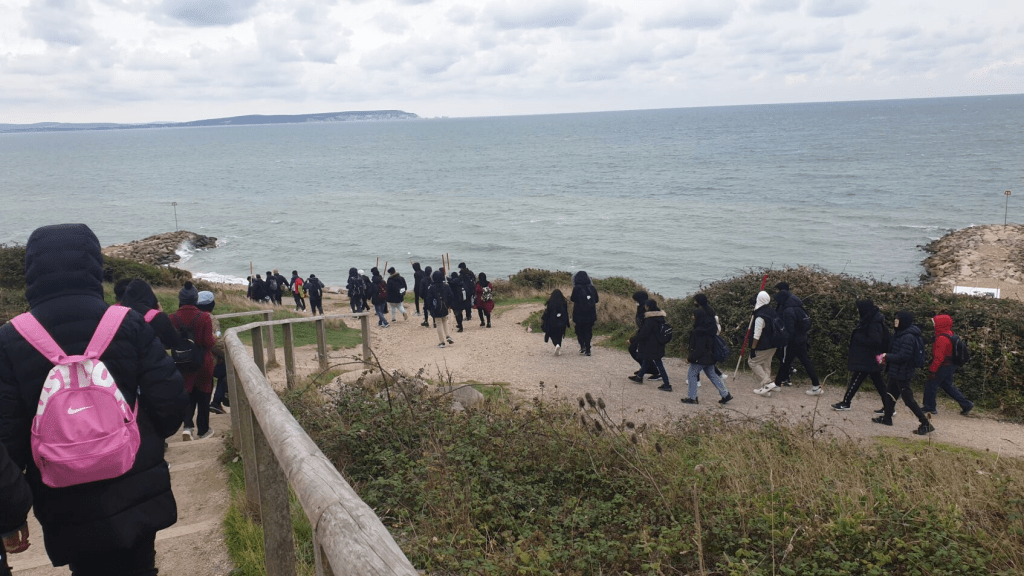
The quote (above) is taken from a Year 11 student on a field trip to a coastal location, where several Muslim students asked me if they could pray during the lunch break. They placed their jackets on the sandy beach behind some vegetation and prayed the mid-day Zuhr prayer in Islam.
‘Allah hu Akbar’, which can be translated to mean ‘God is great’ is what the student leading the prayer recited. The group of students behind him followed his lead and they all began to pray together. What they were engaged in, is called ‘Ibadah’ in Arabic, or worship. When the prayer begins, you will find that the students may not respond to you if you call them or ask them a question. This is not out of disobedience. The beauty of Salah is remembering God, or Allah (ﷻ) and reciting verses from the Qur’an (Majed) which ask for guidance and goodness. For Muslims who choose to adhere to the teachings of Islam, Salaah (or prayer) is considered one of the five obligatory rights of an adolescent Muslim – so if you teach primary school-age students this could be as young as years 5 or 6. Some Muslim students take Salaah very seriously and desire to pray it on time and with full concentration and focus.
Your students may want to pray at certain times, especially during lunch after 13:00pm depending on the time of year. There are five daily prayers in Islam: Fajr, Zuhr, Asr, Maghrib and Isha, which take no longer than 5 to 10 minutes. This requires a wash facility, as students may want to perform ablution of the mouth, nose face, arms and feet – each washed thrice. Be mindful of these prayer times and provide a quiet and private space for the student to observe their religious rights. Boys and girls may want to pray privately to each other. Although, you may find a male student leading the prayer, where he may lightly recite the adhan, or call to prayer. Do speak to the students and their parents to help you in understanding these needs. As you educate yourself about what the students do daily at home and in the masjid (mosque) with regard to Ibadah (worship and prayer), you will feel more comfortable talking to wider school staff about these rights and needs.
The five daily prayers in Islam are a fundamental form of Ibadah, or worship and a valued part of a Muslim’s daily routine. It is good to familiarise yourself with the the five obligatory prayers:
- Fajr: The pre-dawn prayer, performed before sunrise.
- Dhuhr: The midday prayer, observed after the sun has passed its zenith.
- Asr: The afternoon prayer, offered in the late afternoon.
- Maghrib: In the evening, performed just after sunset.
- Isha: The night prayer, observed after the disappearance of the twilight.
The prayers do not take long to pray and consist of a specific number of units called Rak’ahs, which require recitations from the Quran and specific physical postures, including standing, bowing, and prostration. Access to water is important for ablution, however if there is no water available, students can perform Tayammum. This is a purification method in Islam and involves using clean earth or dust to perform dry ablution, which allows a person to purify themselves before prayer or other religious activities. Tayammum is a practical solution for Muslims when in freezing altitudes (or desert environments) where using water would be difficult. To perform tayammum, a person follows these steps:
- Intention: Have the intention to perform tayammum for purification.
- Strike the earth: Gently strike the hands on clean, dry earth or stone, ensuring the palms and fingers come into contact with the dust.
- Wipe the face: Wipe the face with dry earth-covered hands.
- Wipe the hands: Wipe the hands, including the wrists.
Tayammum is only performed in emergency situations, but it is good to know. Some of your students may not have heard of this, so sometimes this extra knowledge deepens the relationship and trust of your Muslim students.
Understanding Spiritual Needs
Before approaching students about their faith or spiritual matters, it is crucial to foster a meaningful and sensitive approach to communication. It is good to cultivate a deep and respectful engagement with Muslim students and their parents or carers to get to know their personal needs and religious obligations. This could include talking about dietary preferences, prayer facilities, and other worries especially for females with modesty concerns. Prompting such dialogue, we show our dedication to inclusivity and respecting their religious, spiritual and cultural needs.
When considering dietary preferences, it is important to be aware that many Muslims eat halal or kosher food (which is permissible in Islam for a practising Muslim to eat). Meats such as halal chicken, beef and lamb, which is generally within the herbivores category along with seafood such as fish. It is important to be mindful that pork is prohibited to eat for Muslims who follow Islamic dietary guidelines. If there are no halal food options available during the trip they can eat vegan and vegetarian, better still, allow the student to bring their own food.
Modesty
Modesty is important to consider, as some Muslim students may adhere to Islamic dress codes, such as wearing a hijab or modest clothing in the form of an abaya (long dress). Boys may want to cover their naval to the knee whilst engaging with activities such as swimming. Be sure to provide access to privacy, in place where they change clothes or shower – the key is to respect their adherence to dress modestly during physical activities.
Creating an inclusive environment is important, especially by educating the other students and assistants on the trip about fellow Muslim students and their cultural and religious rights and beliefs. Do place emphasis on the values of identity, respect and inclusion. Motivate and encourage full participation, while keeping in mind and respecting a Muslim student’s decision to opt out of certain activities that they might feel impinge on their religious rights.
Ramadan Kareem
You may have noticed that this piece has the Islamic date with the Gregorian date. Muslims observe the Islamic lunar calendar, which is also known as the Hijri calendar. This consists of 12 months, just like the Gregorian calendar. However, because it is based on the lunar cycle, the months in the Islamic calendar have different lengths compared to the months in the Gregorian calendar. Here are the 12 months in the Islamic lunar calendar:
- Muharram
- Safar
- Rabi’ al-Awwal (Rabi’ I)
- Rabi’ al-Thani (Rabi’ II)
- Jumada al-Awwal (Jumada I)
- Jumada al-Thani (Jumada II)
- Rajab
- Sha’ban
- Ramadan
- Shawwal
- Dhul-Qi’dah
- Dhul-Hijjah
All these months are useful to familiarise yourself with, as your students will observe various rights that differ from month to month. Islamic religious observances and determining the dates of Islamic holidays is useful, including Ramadan, Eid al-Fitr, and Hajj, among others. Since the Islamic calendar is lunar, it is about 10 to 12 days shorter than the Gregorian calendar, causing Islamic months to shift in relation to the Gregorian calendar each year.
During Ramadan, students may fast from dusk until dawn. Ramadan is the Islamic holy month of fasting and increased Ibadah, observed by Muslims globally, and it is important for students on field trips to feel supported. During this holy month, Muslims fasting will refrain from food, drink, and physical acts (such as sex). Fasting teaches self-discipline; the ability to give up bad habits; empathy for the less fortunate; and increased kindness and spiritual growth. If you have planned an overnight trip, it is considerate to talk to your students about how they would like to break their fast or observe Iftar (meal after fasting). It is also good to arrange a clean place for the students to pray Maghrib Salaah, the evening prayer, performed just after Iftar. If you anticipate being out and about before this time, be mindful that the students may need to take water (small bottle) to perform ablution and a snack to break the fast. Students tend to just keep things discrete, however, it will be appreciated if care is taken with the little things.
Being thoughtful and supportive towards Muslim students on a field trip is about encouraging an atmosphere where students feel included through care, understanding, and respect. By creating safe spaces for individual needs for children from different faiths, we can maintain an anti-racism ethos, where we can promote cultural and spiritual awareness and ensure that every student, regardless of their beliefs and values, feel included and valued within the whole field trip experience. It is critical to support the principles of equity, diversity and inclusion that are integral to fieldwork education. You can apply this to students from other cultural or faith backgrounds, such as Sikh, Hindu, Jewish and Christian students (and fellow teachers and support staff). Knowing who your students are is essential to improve their experience of going on a field trip with you. Trust me, they will remember you for it.
As always, thank you for reading this.
 Salaam Geographia
2 thoughts on “Fieldwork and Supporting Muslim Students”