GA Annual Conference 2024: Reflections and Insights
We live in a world where the reproduction of eurocentrism, colonialism and ‘whiteness’ still unnaturally pierces through our educational systems, therefore the importance of decolonising teaching practices are evermore important.
Written by Iram Sammar
Date: 29 Ramadan 1445, AH (8 April 2024)
This year the 2024 Geographical Association Annual Conference and Exhibition, has been one to remember, where many decolonial ideas and praxis have found their way into mainstream geography education. Two years back I shared my classroom stories and the Bus Ride Home: ‘Go back to where you came from’ (click to watch the whole Teach Meet for 2022) where I explored ideas about decoloniality and what it means to be an antiracist geography teacher. Since, I have celebrated a published article titled, Decolonial and Antiracist Pedagogy through Personal Geographies. This year, Denise Freeman’s presidency saw an important theme manifest into an important collection of ideas and collaborations to continue these transformative methods and strategies. With the intention of diversity and inclusivity, the presidential theme Geography for Everyone proved to be a successful one. This blog is a reflection to highlight largely my own key takeaways, so any critique and complements are subjective to the lens from which I view things – yes, decoloniality and antiracism at the heart of the experience.
Geography for All: Navigating Spaces as a Muslim
“In the World through which I travel, I am endlessly creating myself.”
(Quote from Frantz Fanon)
There is a stark reality that, despite the increasing consciousness and observance of diverse voices within geographical spaces in the UK, the dominant narrative and mainstream audience often remain predominantly reserved for ‘whiteness’. Fanon’s quote above reflects the difficulty of navigating a society, that isn’t designed for you. This reflects the absence(s) of representation, which can enforce barriers for marginalized communities, such as in this case Muslim geographers, who may struggle to navigate these spaces and to fully engage in such events. Again, it is a reality that forces us to confront the fragile balance of inclusion and exclusion, where sometimes, regardless of our greatest efforts, there are always some voices inadvertently sidelined or erased from these spaces.
In hindsight, there is a resilience that manifests from the faith of Islam itself, in my commitment to critical thought and inner peace, I valued sharing my presence at the conference. It felt as though I embodied a physical recognition that, as a Muslim woman, I can (and will) navigate a world where someone like me must sometimes ‘win some, lose some.’ There is is big ‘however’, that again another reminder of the critical awareness of our presence as Muslims (and) women, the acknowledgment of the value of our commitments and contributions to the wider debates and discourse in geographical education as addressed by the late Dr Azeezat Johnson (may Allah ﷻ grant her a high status in Jannatul Firdous, or Heaven). I have not even begun the intersectional elements of my own identity that are rooted in South Asia, the Global South; or the Indigenous privilege of belonging to peoples of ancient Al-Hind; or modern (post)colonial era India; or emerging decolonial era, Pakistan. Born and raised in the urban struggle of the UK context, where Tupac Amaru Shakur reminds us of the urban rose, breaking through the barriers of concrete systems – not designed with me and my intersectional identity in mind.
I chose to attend the conference for a number of reasons, but I must confess, it was more about embodying my intersectional identity within a space I felt alienated in. As Frantz Fanon eloquently stated, ‘each generation must, out of relative obscurity, discover its mission, fulfill it, or betray it.’ In echoing the sentiments of bell hooks and el-Hajj Malik el-Shabazz (Malcolm X) and decolonial thinkers before us, I am reminded of the imperative to confront systems of oppression and to assert our presence in spaces where our voices deserve to be heard.
As Ramadan Kareem graced Muslims around the world, it was also the third consecutive year of the GA conference where both dates contended. It really was with intense consternation I approached the conference. Although the spirit of the blessed month indulged me with tranquility, gratitude and reflection, I could not contravene the disappointment of being fully aware that many of my fellow Muslim geographers were unable to attend. In all honesty, there were moments when I contemplated whether I should attend or be there at all. Guilt, as I feel as ‘if’ I could have been engaging with worship in the last ten days of Ramadan Kareem whirled in my consciousness. As I grappled with my spiritual constellation with this blessed month, I also had the desire to share that sentiment with fellow comrades in the Decolonising Geography Collective who came to the event, and the many friends within the geography community.
Attending the conference was not only about professional development for me, or the amazing networking opportunities; it was more about embodying my faith and representing the diverse community to which I belong – a community that is often marginalized or overlooked in academic spaces. Ambalavaner Sivanandan founder of the Institute of Race Relations once was quoted to have said, ‘We do not speak to, but from’ (quote selected by Gary Young cited in Communities of Resistance). I feel this quote resonates with the whole perception that although there are allyships and comradeships for marginalised communities to seek refuge in, real change only comes ‘from’ within a community or peoples going through oppression of some sort. Taking from the sentiments of bell hooks and el-Hajj Malik el-Shabazz (Malcolm X), I am reminded of the imperative to stand before and confront systems of oppression and to (re)assert ‘our’ presence in spaces where our voices need to be heard. As Dr James Esson eloquently reminded us in his soul-nourishing keynote lecture, ‘it is disrespectful to those who came before us’, to not acknowledge all the contributions to the discipline of geography and our knowledge(s) that shape how we might think and where we find ourselves in knowledge production in the present. A beautiful keynote lecture, by a beautiful soul. To see Salaam Geographia alongside the Decolonising Collective and Dr Joanne Norcup’s crucial revival of #CIGE the ‘global movement of educators, researchers, students & artists #DawnGill inspired’, made me hopeful. Joanne points out that although people were aware, knew of, and engaged with materials from the 1980s courtesy of the GLC & ILEA anti-racist inspectorate, she still spent ‘a decade recovering dispersed archives & writing/publishing is more than “collating” #citeright #histgeogsantiracism project.’ See Geography Workshop for the CIGE online materials. It was heartening to read Steve Brace’s post on acknowledging the body of work that already exists, as highlighted by James (see a post on X retweeted by Hermione). As Steve embarks on his journey as the new CEO of the Geographical Association, it is refreshing to be ‘seen’ and ‘heard’ by those comrades in powerful positions making time to speak to and involve people like myself. Steve took the time to speak to me individually and made me feel valued and important in such a massive event – this is an example of the impact of a small kind gesture.

Despite the dates of the conference posing a logistical challenge for those observing Ramadan, we should reflect on these moments when our presence becomes even more significant. It is a testament to our commitment to raising awareness about Critical Muslim thought in Geography Education and to advocating for greater inclusivity within academic spaces and schools.
So, as I reflect on my decision to attend despite the obstacles, I am reminded of the words of Malcolm X: ‘A man who stands for nothing will fall for anything.’ Our presence at events like the Geographical Association Annual Conference and Exhibition is not just about attendance; it’s about standing firm in our identity, asserting our worth, and demanding to be valued for the invaluable contributions we make to our communities and to the world at large.
Creating Space for Decolonising and Antiracism
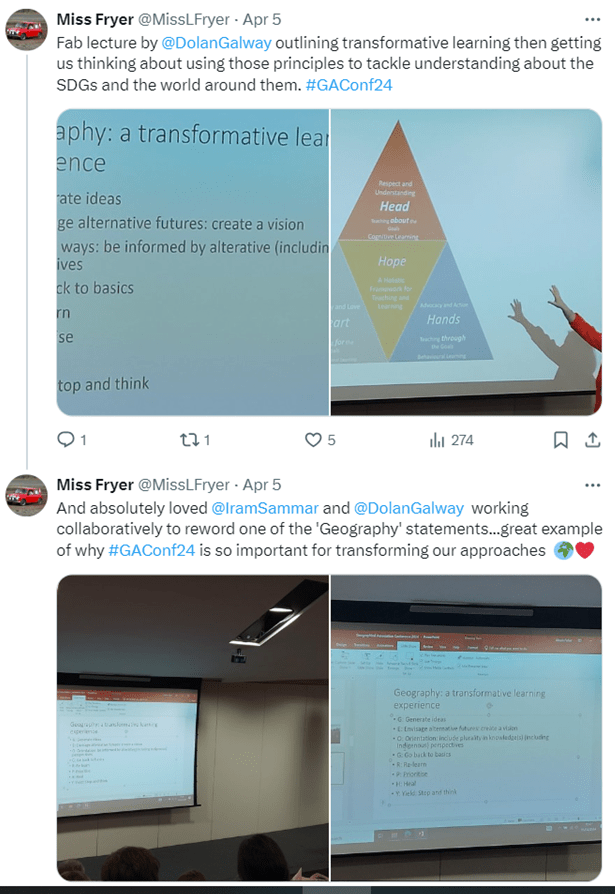
Decolonising is more than changing the curriculum and rethinking how we teach case studies near and far, it should be in our consciousness. @MissLFryer, in her post kindly documents what true Engaged Pedagogy, as advocated by bell hooks, looks like. During the question and answer session, Professor Dolan Galway accepted my critique of her initial ideas on Geography as a transformative learning space. I pointed out that ‘Other ways’ could be viewed as an Orientalist way of demonstrating transformative learning, so I suggested ‘orientation’ be used instead. Hope and Izzy encouraged me to speak out and ‘just say it’, so I was also able to help Professor Galway change the sentence so ‘Indigenous’ is capitalised and conceptually ‘plurality in knowledge(s)’ is added, informed by my engagement with Professor Tariq Jazeel’s writings on postcoloniality and decoloniality. We were impressed how Professor Galway jumped onto the computer and quickly amended her PowerPoint slide there and then. It was very emotional for onlookers to witness – a demonstration of the learner being taken seriously by the teacher/lecturer. I thought of Kit Marie Rackley, an individual who has been very active advocating for Indigenous Peoples’ knowledge(s)/rights within Decolonising Geography collective, so learning through their work has been invaluable – I have been able to manifest strength to speak up, even if you feel marginalised, or not ‘heard’ or ‘seen’.


This brings us to the session planned by our team of talented decolonial teachers (engaged with the Decolonising Geography collective) for the GA Secondary Phase Committee (@ga_spc), where a fellow geographer said, ‘it stood out as a beaming example of progress and empowerment.’ Stephen Schwab, chair of the committee with his ongoing support and encouragement helped us title the session: How to begin the process of decolonising case studies for Key Stage 3 to Post 16 Geography Education. It was a horizontal effort led by a trio of passionate educators, myself and the dynamic duo of Hope and Izzy, so the session was packed with hands-on exploration of practical strategies, rich ideas, and invaluable resources for rethinking the narrative of geography education. We initially met up on a few occasions before we embarked on a journey to unravel the complexities of colonial legacies, fuelled by a commitment to reframing our own teaching methodologies and empowering our students to engage critically with the world in which they live and share.
I began the session by demonstrating my passionate dedication to redefining the narrative surrounding colonialism and decolonising through personal geographies and heritage. My fifteen minutes initially delved into the profound insights of Professor James Esson for defining decolonising; and Professor Sarah Radcliffe, in defining colonialism. Both demonstrate academic brilliance as guiding lights illuminating our understanding of complex terms toward a more inclusive and equitable education system.
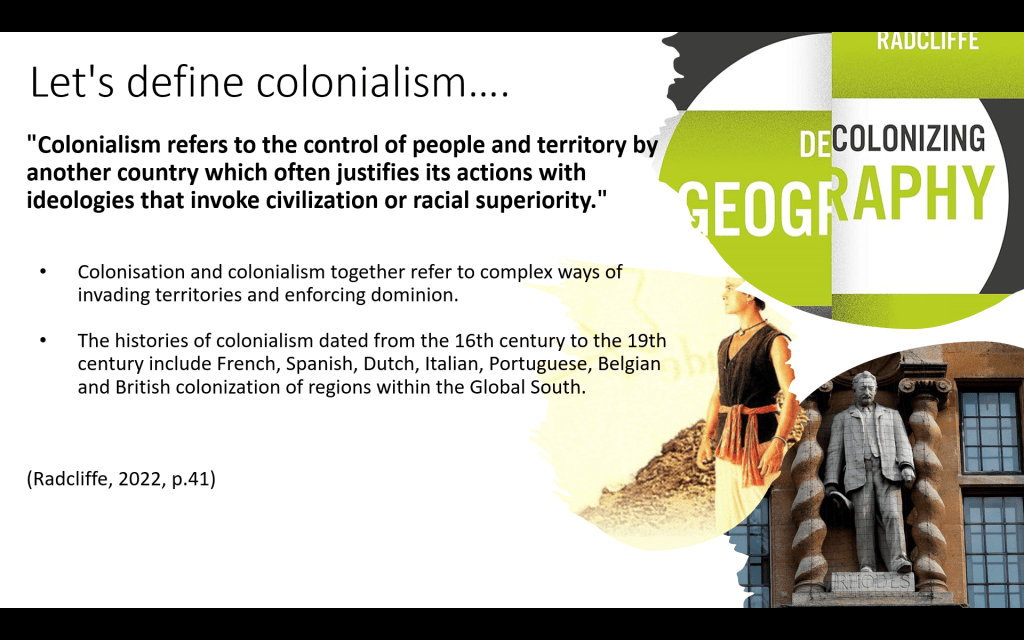
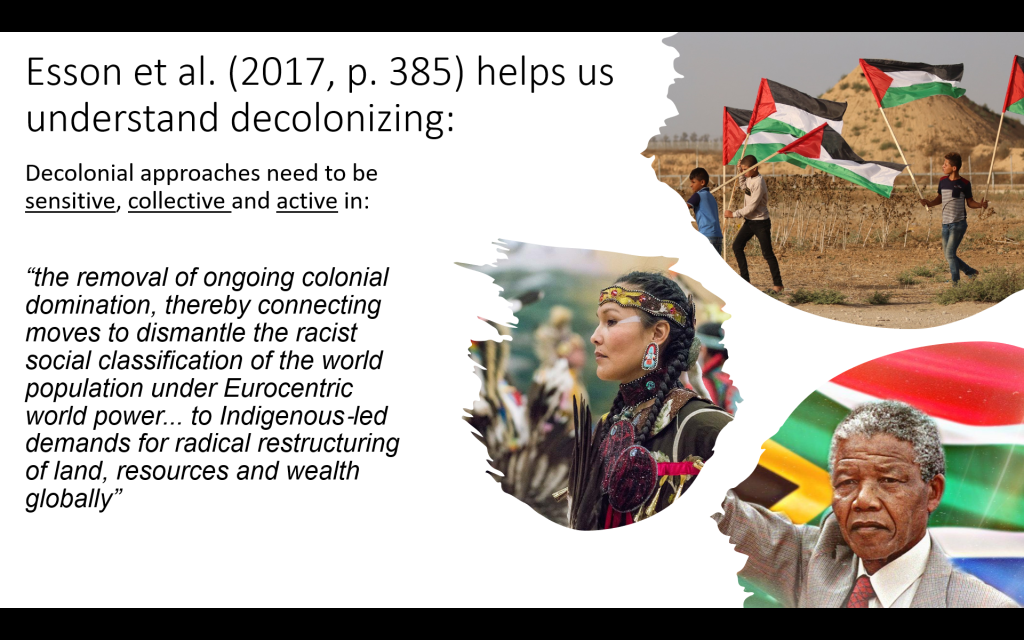
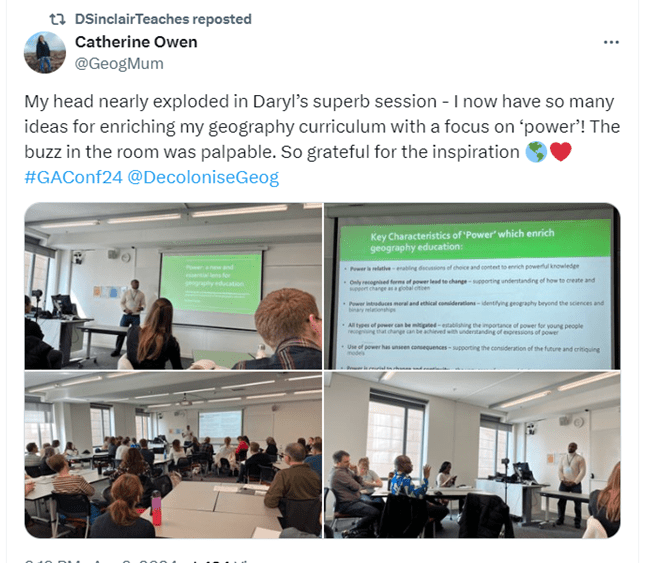
Our session’s exploration began with a deep dive into the concept of colonialism itself, deconstructing its significant and complex impacts on both past and present societies. Taking from personal geographies and scholarly discourse, we helped the audience navigate the complex terrain of colonial histories through definitions and case studies, acknowledging the blemishes they have left on the landscapes of education. We aimed to present a session that modelled the transformative power of decolonising case studies we already use in the classroom – often inherited, where choice is limited. The pivotal tools in shaping students’ understanding of the world was explored to help our audience recognise how traditional case studies often perpetuate colonial narratives and uphold dominant power structures. The concept of ‘power’ was further explored in Daryl Sinclair’s own amazing session later, the following day (see Catherine Owen’s post below). Thus, our mission within the Decolonisng Geography collective has always been clear: to decolonise our case studies and offer students a more nuanced and plural perspective informed by collaborating with decolonial thinkers.
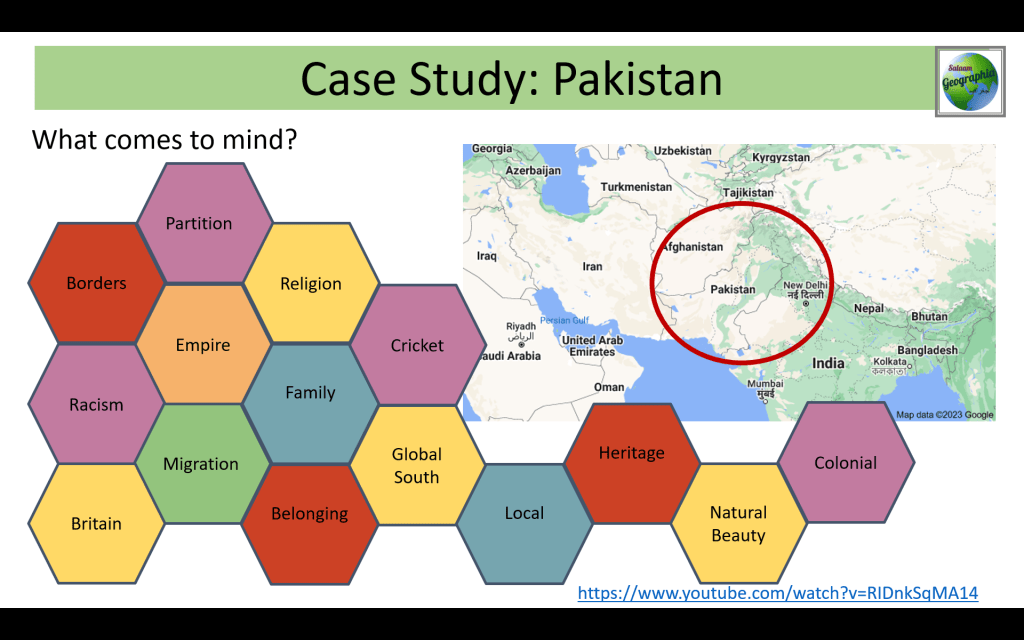
With our own session, we passionately embarked on this journey of decolonisation, using practical examples from our own classrooms as guiding strategies. I shared insights from the Pakistan case study, demonstrating how a hexagonal method can serve as a powerful framework for deconstructing colonial perspectives and embracing the richness of diverse cultural narratives. This way teachers can feed in important themes and narratives often left out in the textbooks and GCSE and A level specifications, within the UK context.
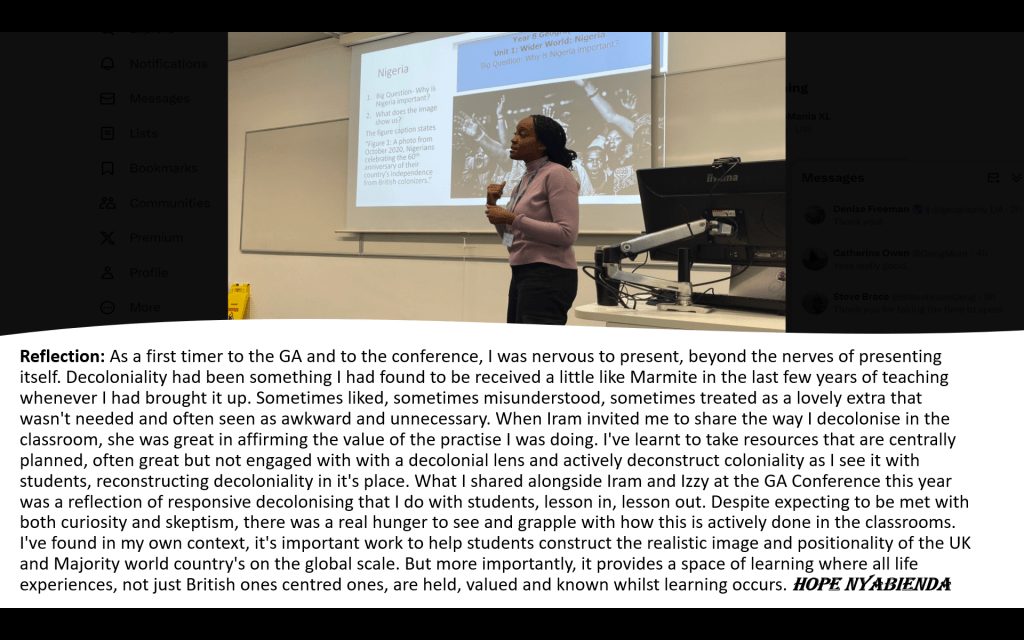
Hope, with her infectious enthusiasm and early career commitment, guided us through the process of decolonising the Nigerian case study inherited from a more traditional resource from years before. Through her lens of ‘pride’ and ‘identity’ she helped the audience experience the challenge of reimagining Nigeria not only as a product of colonial exploitation, but as a vibrant example of culture, resilience, and heritage. She asked the floor to critique the given resource sheet, so it could be seen how flawed older resources in departments can be. Together we grappled with how teachers might begin the process of decolonising through a discussion of why the resource was centered around a Eurocentric worldview. The atmosphere was electric and conversations lasted through lunch (although I was observing a fast).
Izzy brought her invaluable expertise to the session, offering practical strategies and real-world examples to empower educators in their journey towards decolonisation – with a particular focus on Colombia and the geographies of Latin America. Together, with her personal geographies, she wove a tapestry of inspiration and empowerment, equipping attendees with the tools and insights needed to embark on their own transformative journeys. Izzy demonstrated practical ways to decolonize the Colombian case study, aiming to shed light on the diverse richness of Colombia beyond stereotypical narratives around crime and poverty. With a keen focus on indigenous communities, Izzy’s approach shed light on the integral role diverse groups play in shaping Colombia’s cultural tapestry, where she talked about how ‘real interviews’ from her own qualitative methods were incorporated into her lessons – with migration stories from Venezuelans. By delving into the traditions, languages, and customs of indigenous peoples, Izzy talked about engaging learners with a deeper more nuanced understanding of Colombia’s intricate socio-cultural landscape. Through this decolonial perspective, Izzy demonstrated the resilience of Indigenous communities and shared insights of their ongoing contributions to Colombia’s identity and heritage, hence a more inclusive and comprehensive understanding among her learners.
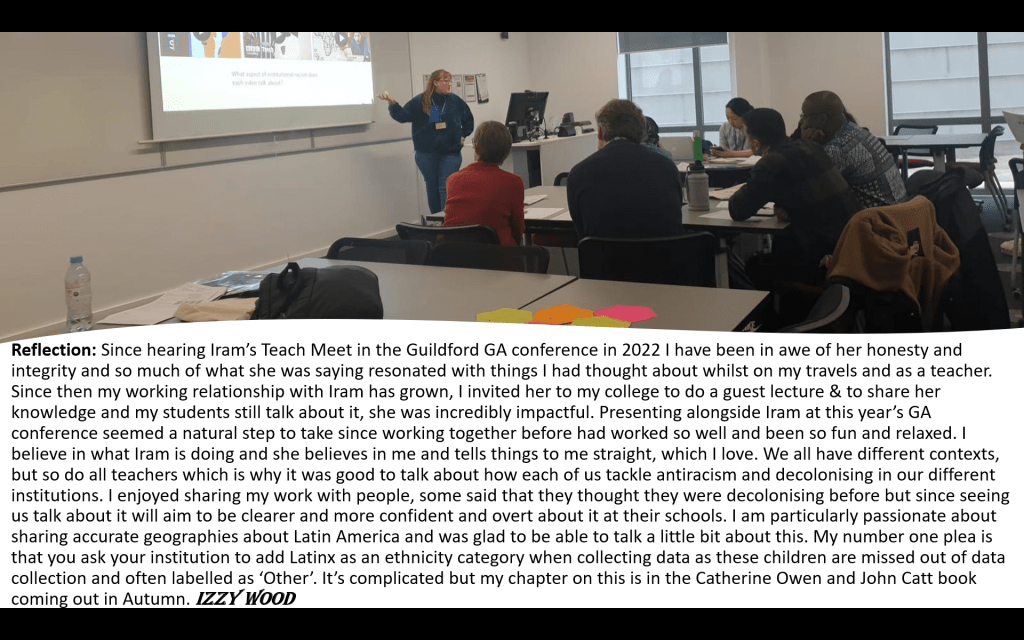
Our session was more than just a series of fifteen-minute presentations, we viewed it as a collective call to action, a loud demand for change within the field of geography education. As we shared our experiences and insights, we were told we ‘energised the room’ and sparked a flame of hope and urgency to initiate a decolonial move towards a more inclusive and equitable educational classroom experience.
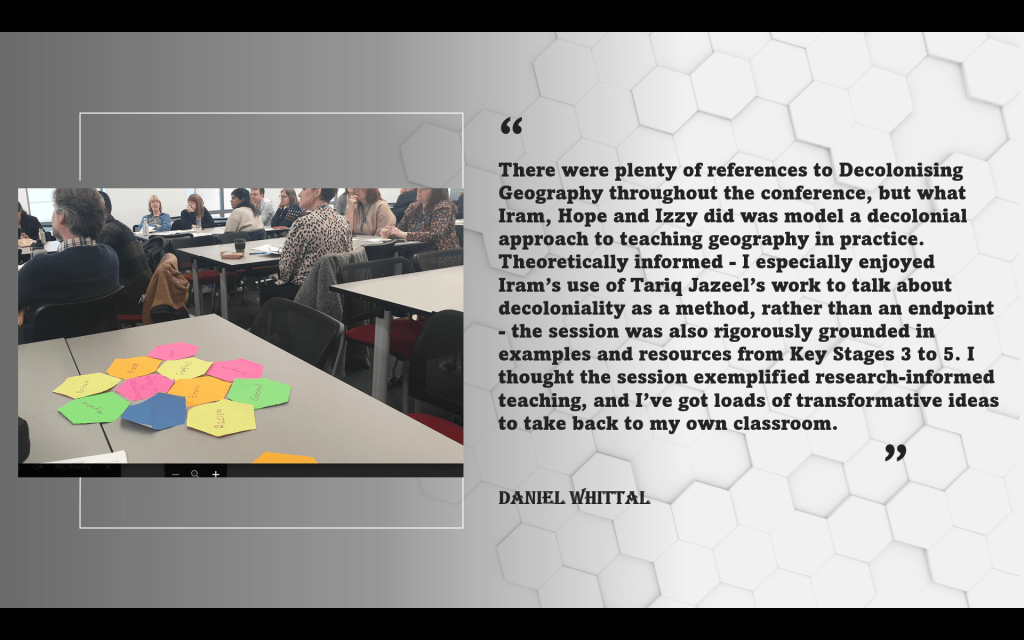
The Geographical Association Annual Conference has indeed served as a crucible for the possibility of change, with the continuing of conversations and scaffolding of action towards a more just and decolonial future. As educators, we all have a responsibility to challenge the mainstream ‘whiteness’ and ‘colonial’ narratives within geography education, this includes disrupting the entrenched power structures and uplifting marginalised voices. By decolonising geography case studies, we are not only reshaping the curriculum – we are empowering students to create a new world for themselves, one of change, filled with plural knowledge(s), empathy, and critical thinking skills, so learners and teachers can imagine a better world.
The process of decolonisation may be long and tough, but with love, dedication, and collective action, we can help students and teachers imagine a future where every learner’s voice is heard, every culture is known and respected, and every narrative is valued. United and through collaboration, we can embark on this transformative journey together, manifesting an improved trajectory towards justice, coexistence, and equitable futures in our world, especially for the many generations to come.
Sharing Research in Geography Education
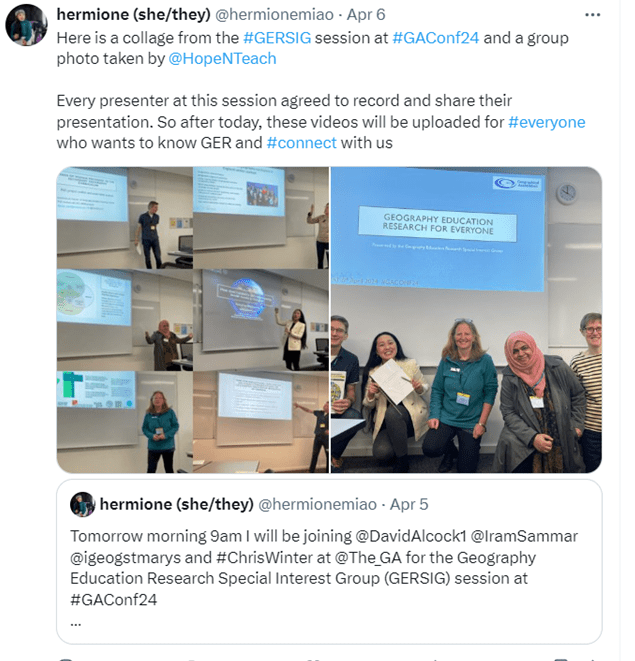
After some wonderful catch-ups with fellow Decolonising Geography members, I prepared for the Geography education research for everyone session with David Alcock and Dr Hermione – here I briefly shared my own doctoral research so far. It was very useful to explore the fascinating research in Geography Education, especially as it was directed towards impacting teachers, researchers and students who are interested in becoming engaged with research. We all had the opportunity to select aspects of our research and present a five-minute summary – which for me was never going to happen. Keeping to perfect timing when talking about research is so difficult, particularly for those who have so much to share. It really was a fabulous idea and the session sparked important discussions about funding, collaborations and moves towards a progressive and transformative geographical educational experience ‘for everyone.’ My focus was on rationale and impact.
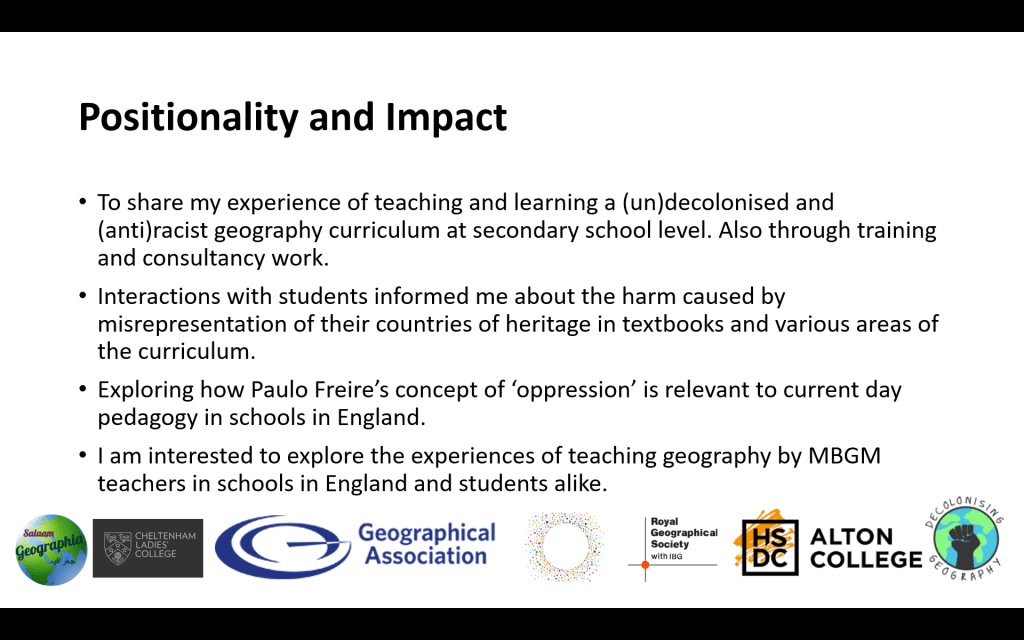

My research starts with the simple, yet complex inquiry into Who am I? With this activity, we are able to make connections with the local, regional and more global realms of the world. Before I begin any discussion in the classroom about identity, race, or heritage, I do so by requesting people take a minute and think about the following questions:
- Who are you?
- Are you a part of the ‘coloniser’ heritage? or ‘colonised’ heritage? Or perhaps both? In light of what I have discussed so far.
- What connections can you make between colonialism and the discipline of geography as we know it today?
In terms of impact, I now offer CPDs for geography teachers and educators and talk about how this activity can open up dialogue with your students and have written an article for Teaching Geography (GA journal for teachers) and numerous blogs.
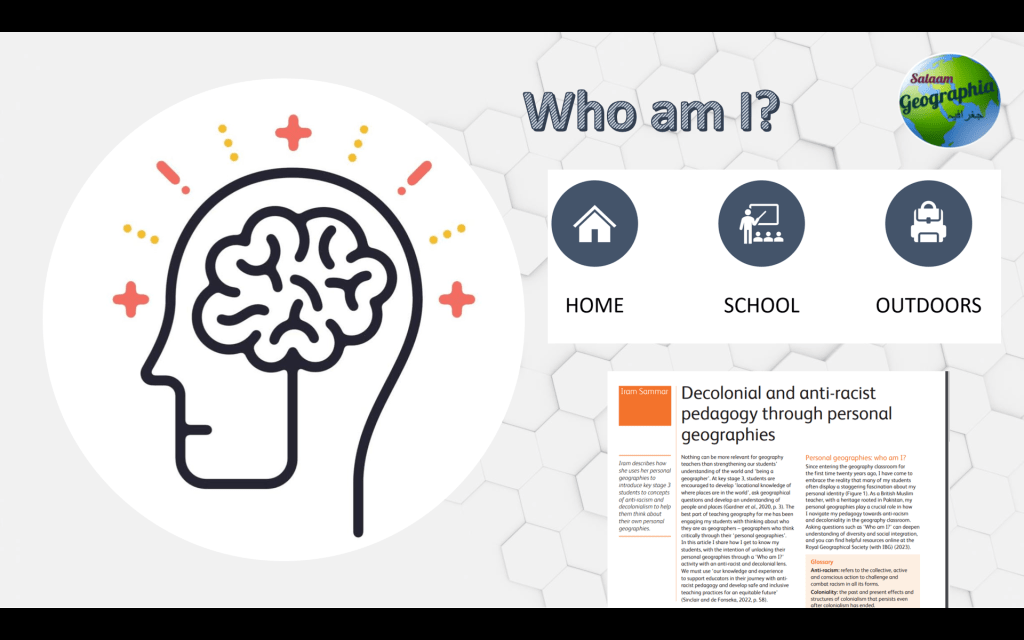
So let me talk you through my personal geographies!
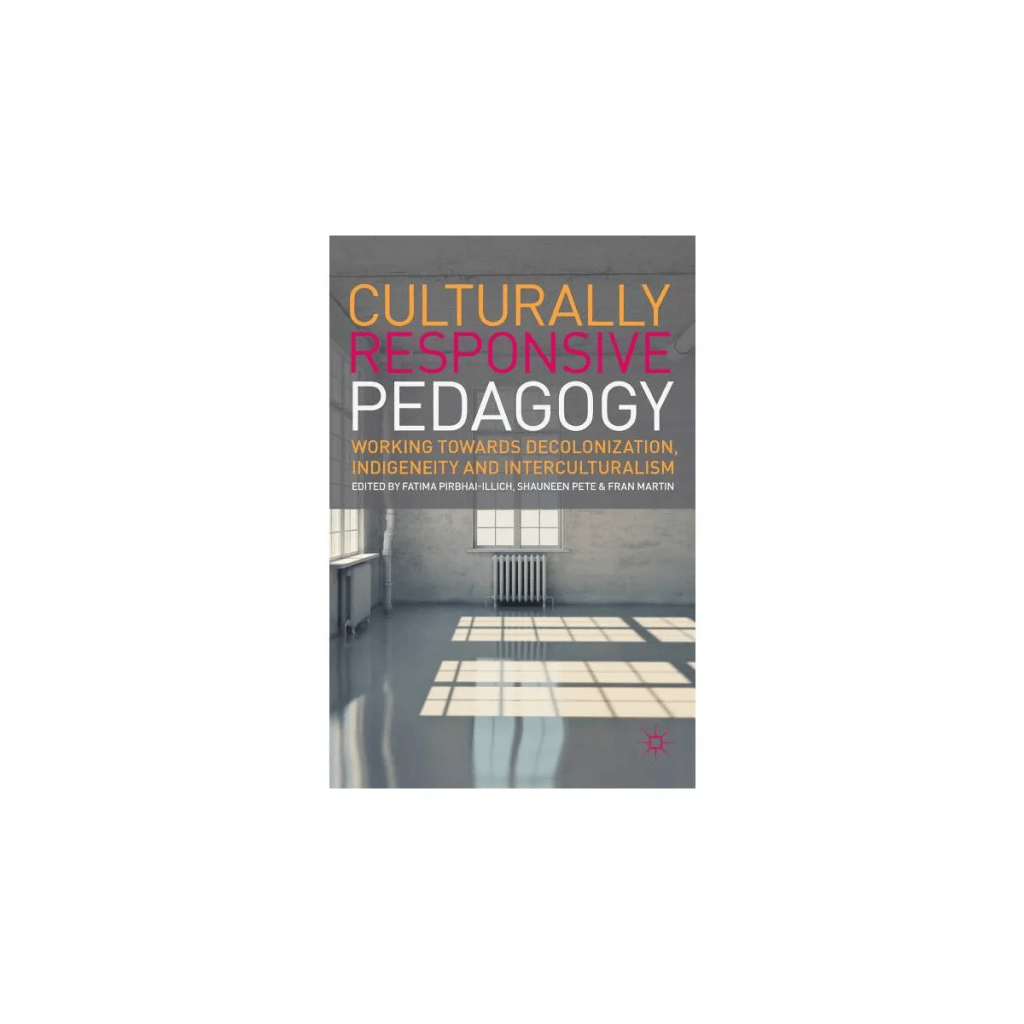
I would say, I have a heritage rooted in Pakistan which is in South Asia, hence a former colony of British Empire …as Pakistan was a part of India…before partition – where India was colonised by the British…Known as the British Indian Empire…but known in Arabic as the Al-Hind, or Indigenously known as Hindustan. So, I position myself within the lens of a former ‘colonised’ heritage. It is important to think about the importance of this question because my world view is probably a whole lot different to say someone with a heritage of the ‘coloniser.’ So if you are British white it places you in the ‘coloniser’ heritage category -not to suggest a person within this positionality is perpetuating such ideologies attached to it. This questioning comes from the text Culturally Responsive Pedagogy (see Fran Martin and Fatima Pirbhai-Illich et al, 2017), where Fran in her talks mentions that she is from a ‘coloniser’ heritage; and Fatima mentions she is from the ‘colonised’ heritage. Useful to understand how our thoughts can be so different. Where one might be healing and the other might need to show patience and be comfortable with the uncomfortable. So coming back to this idea of Who am I? you can see straight away, all the global and local geographical links you can share with your students.
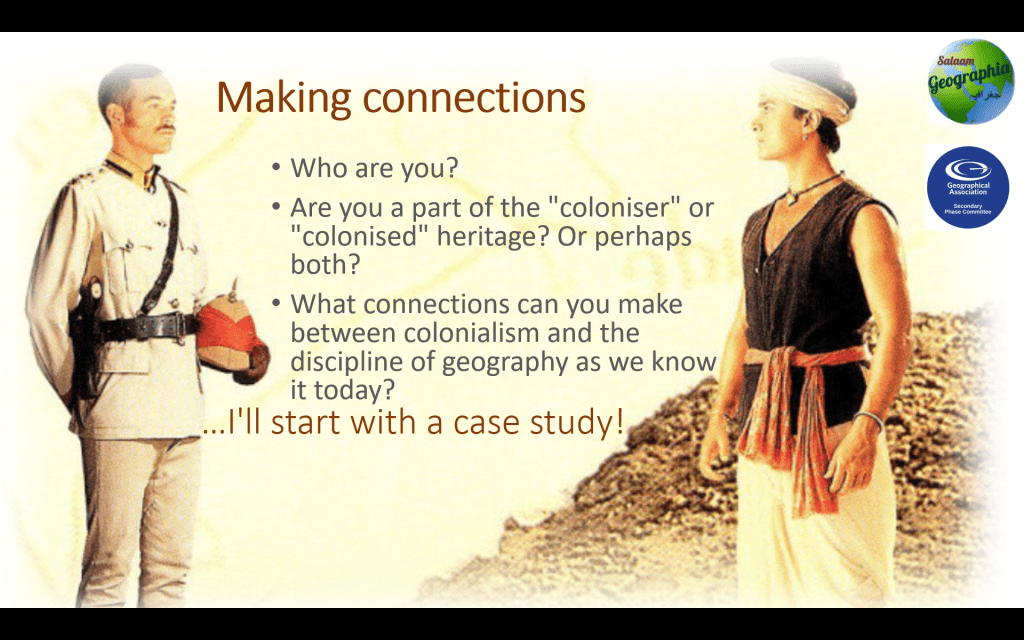
I start with an image from the Bollywood movie Lagaan. I use this image to demonstrate to my students what life must have been like for those colonised by the British Raj. I could talk in-depth about each character in the movie with this image but you may want to listen to my very first presentation for GEReCo. This indicates that we must approach texts like Prisoners of Geography (as mentioned by Dr Esson in his lecture) with caution, especially some of the statements that try and explain the geopolitical relationship between India and Pakistan in a very stereotypical and divisive way – as a Pakistani heritage geography teacher, I find the chapter on India and Pakistan very difficult to read. I feel it lacks the nuance of some of the realities faced by these countries and its peoples – and Britain’s role in causing those colonial harms and conflicts.
Just by looking at these images and movies, you can see the hybrid nature of my existence, because of my unique positionality as Muslim, Pakistani, Female Geography teacher teaching in England, UK. A bit of a mouthful, right? But something I bring to the geography classroom, not by choice – but because this is what the students see when I enter the room. Now I have embedded it within my research.
So, when you next meet your students have a go at decolonising, with you, they too will share their expertise about their own personal geographies – if you haven’t already, try this in your classes. Be sure to drop me an email on how it went. Remember, your students need to explore the geographies embedded within their own lives as they are the experts of themselves…hence their personal geographies.
I do hope you enjoyed reading through this reflection and that it has given you something to think about when engaging with decolonising geography and the process involved. I look forward to Hina Robinson’s presidential year with the GA, and I am very much excited about this conference taking place in Oxford ‘where I spent most of ma days…chillin’ out, maxin’ …relaxing…♫♫♫’ (guessed the song?). Hina has been an inspirational figure in Decolonising geography and her podcast with Professor Tariq Jazeel sparked an interest in me to pursue what decolonising is and what it could mean to students of geography within school and beyond – hence I am now ‘doin’… ma doctoral’ writing chapters with the ‘big boys’ like Professor Steve Puttick (if I may Steve!) at Oxford University.
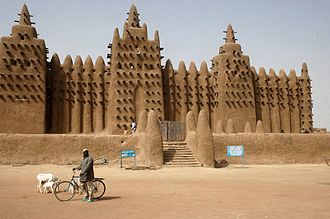
Thank you for reading and enjoy learning, unlearning and teaching through decolonial and antiracism praxis. Representation matters, as Aisha Thomas emphasises in her book. I leave you with an image below of الجامع الكبير في جينيه (or the Great Mosque of Djenné) in Mali. It means a lot to me as I spotted one of my PGCE tutors Dr Alun Morgan at the conference after Professor Esson’s transformative keynote lecture. I had the opportunity to reconnect and tell him how, his showing an image of this masjid meant the world to me during my own teacher training days, as I felt represented through my Islamic spiritual embodiment. We both felt the emotion because I had never had the chance to tell him, it was his ‘unconscious’ culturally responsive pedagogy through showing the group this image, that I felt I belonged in the geography community. This small pedagogical act informed how I taught thereafter and also inspired me to explore Islam and geography for my Masters and not shy away from who I am. Another blog on this is incumbent on me. I could mention many more amazing geographers (and sad I haven’t, but I value you), but until next time, Peace and Salaams.
السلام عليكم ورحمة الله وبركاته
 Salaam Geographia
2 thoughts on “GA Annual Conference 2024: Reflections and Insights”