[Download the full resource below]
Written by Iram Sammar
Date: Rabi (1) 10 , 1447 AH (September 2, 2025)
Getting to know students is not just a warm-up activity at the beginning of the year—it is an act of justice and care. Both Paulo Freire and bell hooks remind us that education is never neutral: it either reinforces systems of oppression or becomes a space of liberation. Freire’s Pedagogy of the Oppressed challenges teachers to see learners as co-creators of knowledge, not passive recipients. Similarly, bell hooks’ Engaged Pedagogy emphasizes that teaching should honor the whole person—their histories, identities, and lived experiences.
When geography teachers take time to learn who their students are, they signal that every learner’s story matters. This shifts the classroom away from domination and toward community, dialogue, and mutual respect. hooks reminds us that real education begins with care, presence, and vulnerability—teachers showing up as whole people, and making space for students to do the same.
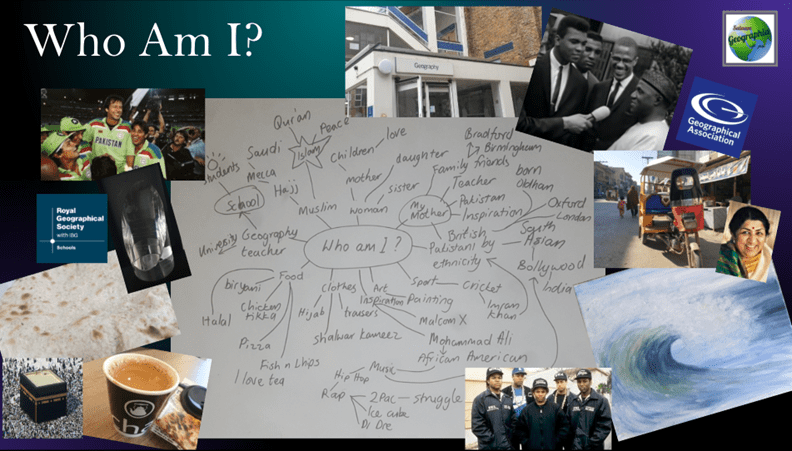
A practical starting point is a simple “Who Am I?” resource. This tool invites students to share aspects of their identity, interests, learning styles, cultural backgrounds, and goals. It doesn’t have to be complicated—it could be a short reflective writing, a visual project, or even a guided discussion. What matters is the teacher’s willingness to listen deeply and to weave those insights into the fabric of the classroom.
By beginning with “Who Am I?” and returning to it throughout the year, teachers enact the engaged pedagogy hooks describes: one where students are seen, valued, and empowered to participate fully in their own learning.
Further reading
Sammar, I., 2024. Decolonial and anti-racist pedagogy through personal geographies. Teaching Geography, 49(1), pp.22-25.
Download the Who am I? resource below
 Salaam Geographia