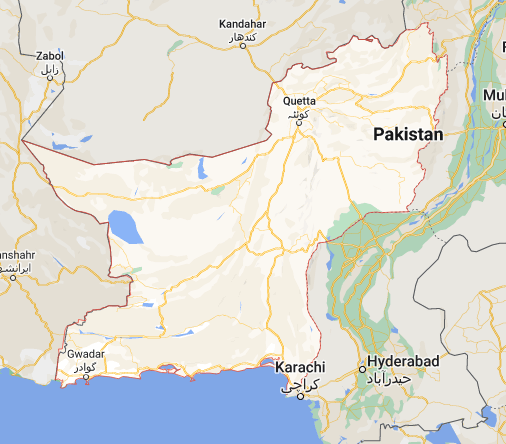
RGS-IBG Annual International Conference 2025: Reflections and Highlights

Image by Iram Sammar

Geographies of Creativity / Creative Geographies

Written by Iram Sammar

Date: Rabbi 1 26, 1447 AH (18 September 2025)

The Royal Geographical Society (with the Institute of British Geographers) Annual International Conference 2025, chaired by Professor Patricia Noxolo was held at the University of Birmingham and online from Tuesday 26 August to Friday 29 August 2025, on the theme Geographies of Creativity / Creative Geographies. The conference was an incredible experience for me personally, opening spaces where participants could share not only their research but also the inner feelings of joy and distress tied to marginalisation, race, and the lived realities of ‘being’ othered and reclaiming identity. Creativity and the geographies aligned were embedded within the conference, from global music, culture and art to spirituality – including Qur’an recitation. In my case, being Muslim and racialised by the mainstream discipline of geography, I do not find it easy to show up visibly in predominantly white spaces. It was a refreshing surprise to feel the love and warmth of those involved in the organising, presenting, and observing of this year’s conference.

One of the most powerful moments of the conference for me was in collaboration with the RACE working group of the Royal Geographical Society. This group marked its 10th anniversary this year with a pre-conference gathering, The Azeezat Johnson Memorial RACE Pre-Conference Event 2025 that, as always, created space for postgraduate and early career researchers to connect and share their journeys. I am a relatively new member and postgraduate representative alongside Charden Pouo Moutsouka. What stood out was how the conversations stretched beyond the well-worn idea of the “leaky pipeline” to address the fuller spectrum of Black and Brown student experiences, career trajectories, and the intersections of academic work with community activism. We welcomed two exceptional researchers, Dr Lyn Kouadio postdoctoral reader at Oxford University, and Saffron Powell PhD candidate at King’s College London, to share knowledge on their research, respectively. Saffron shared elements of her research and talked about how current teacher education policy fails to support initial teacher education providers in developing antiracist teachers. She spoke about how such educators can empower all students and prepare them for a ‘diverse and multicultural world,’ whilst providing meaningful education for racially minoritised students and colleagues. Lyn, who is a Beacon Junior Research Fellow in Postcolonial and Race Studies, shared her research on transnational justice through the politics of epistemic (in)justice in (post)colonial Black (Francophone) Africa. Her current project research focuses on colonial archives in broader repatriation and reparations debates in international politics (see link).  Karina Kanda, Azura Farrell-McLeod, and Obinna Iwuji in their presentations, shared beautiful poetry and reflections on their amazing research.

What stuck with me and everyone in the room was Anita Shervington’s concept of cultivating community-rich projects so beautiful flowers can grow for us to harvest. Those flowers are a metaphor, seen as the final product of the hard work that Black and Global Majority people put in, so communities can flourish. Anita spoke about BLAST, a pop-up festival and engagement platform that brings together ‘the power of science, arts, and Black culture to drive social, economic, and environmental change’ (see link). She works as a Birmingham-based community engagement strategist. She reminded us in the room, how the work we do as Black and Brown people can be seen as cultivation, and that we therefore must not just let institutions and extractivists harvest our flowers. I am not sure if I have conveyed with the same eloquence as Anita, but I hope this resonates with people working hard to decolonise and work through anti-racism praxis.
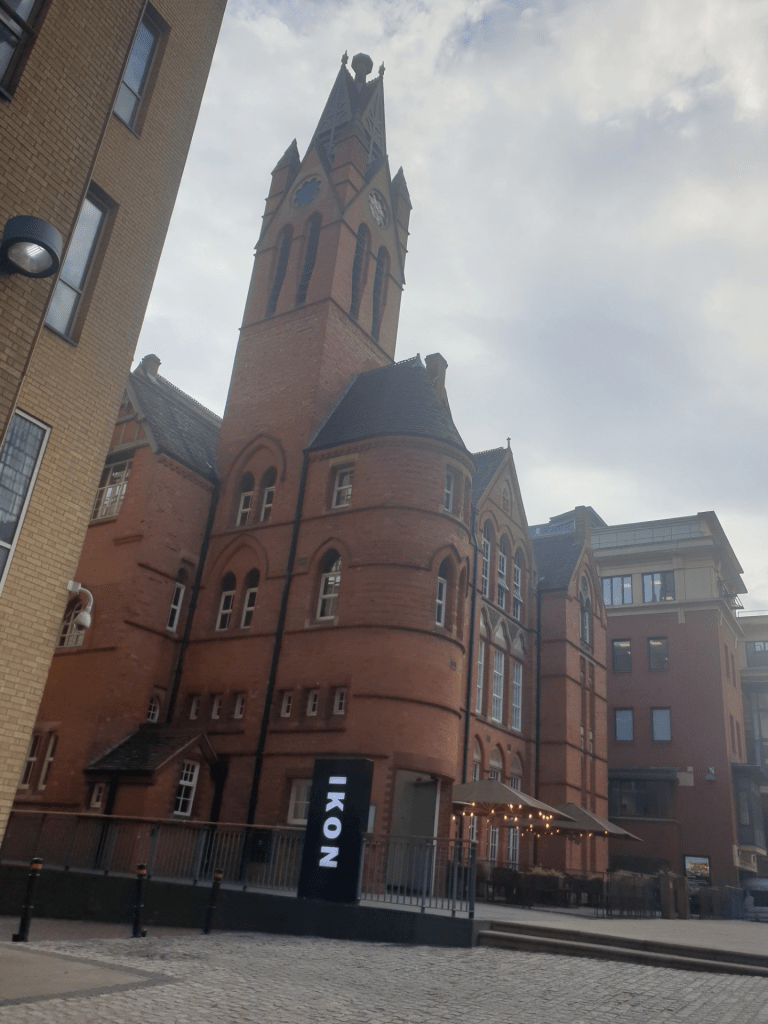
Image by Iram Sammar

These discussions resonated strongly with my own commitments and align with the powerful interventions of scholars like Dr Azeezat Johnson إِنَّا لِلَّٰهِ وَإِنَّا إِلَيْهِ رَاجِعُون, whose work continually urges geography to take seriously race, embodiment, and the everyday politics of belonging. Our sister, Azeezat ‘brought a deeper meaning to the discussions around the geographies experienced by Black Muslim women,’ (quote from a blog). The event closed with a collective reflection on the future of the RACE group itself: questions of whether and how the group should continue, what members now need from it, and how its vision might evolve to meet the challenges of the next decade. I must say the halal cuisine and variety of condiments were impressive, all enhanced by the fact that this event was hosted at Ikon Gallery, Birmingham. Love, respect and care were at the heart of the event.

The following day, another powerful moment came through a session I presented in collaboration with Charden Pouo Moutsouka (University of Oxford). We summoned critical and creative engagements with love, resistance, and power as central themes for reimagining geographies. Our paper foregrounded the often lost or erased epistemologies of communities that have endured racism(s) within their geographical imaginations and lived realities. Our audience was blessed to be in the company of Professor James Esson, where emotion and depth of understanding, and being uncomfortable at times, made space for critical reflections.

Our reflections drew deeply from Black, diasporic, Indigenous, and Global Majority epistemologies, tracing how these knowledge systems embody expansive practices of love and resistance, and how they reclaim sovereignty in the face of racial violence past and present. The session did not simply diagnose oppression; it opened pathways toward collective healing. A guiding question echoed through the room: How can we draw on our own cultural, spiritual, and embodied ways of knowing — rooted in love, resistance, and power — to heal from the ongoing wounds of racism?

This was beyond a call for incremental reform; it was the possibility of a paradigm shift within geography itself. A shift away from frameworks that reduce resistance to what is only ever portrayed through Western epistemologies, and toward centering Black, Indigenous, diasporic, and decolonial knowledge systems. The paper looked to bell hooks and el-Hajj Malik el-Shabazz (Malcolm X) to illuminate how storytelling, song, poetry, art, and prayer serve not just as cultural expressions but as sites of epistemic resistance. From the mothers’ sigh to the sanctity of the home, from pilgrimages to spaces of spirituality. We invited our audience to see how love itself could be understood as a decolonial method. Critically, the paper also urges us to confront the damage left by coloniality and the ongoing failures of Western epistemologies to embrace plurality, especially when grappling with racial trauma and healing. It called for rethinking geographical landscapes not through the tired dualism of “over here” versus “over there,” but through an understanding that the wider world lives, breathes, and resists as one. Watch this space for our journal article, In Sha Allah.
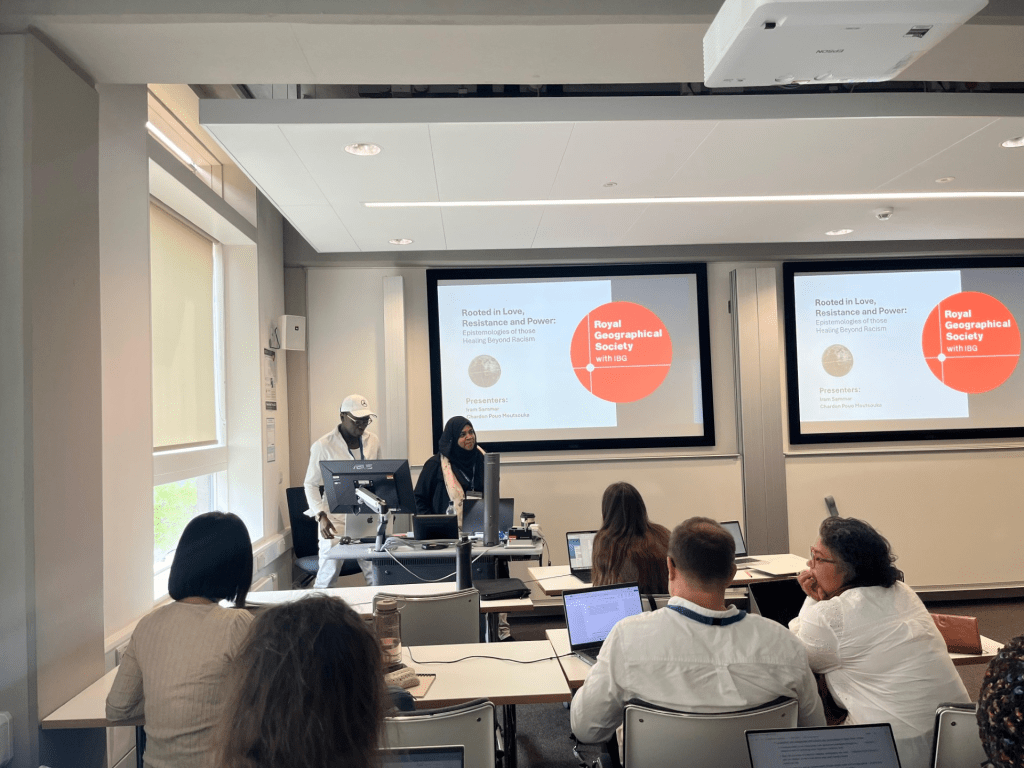
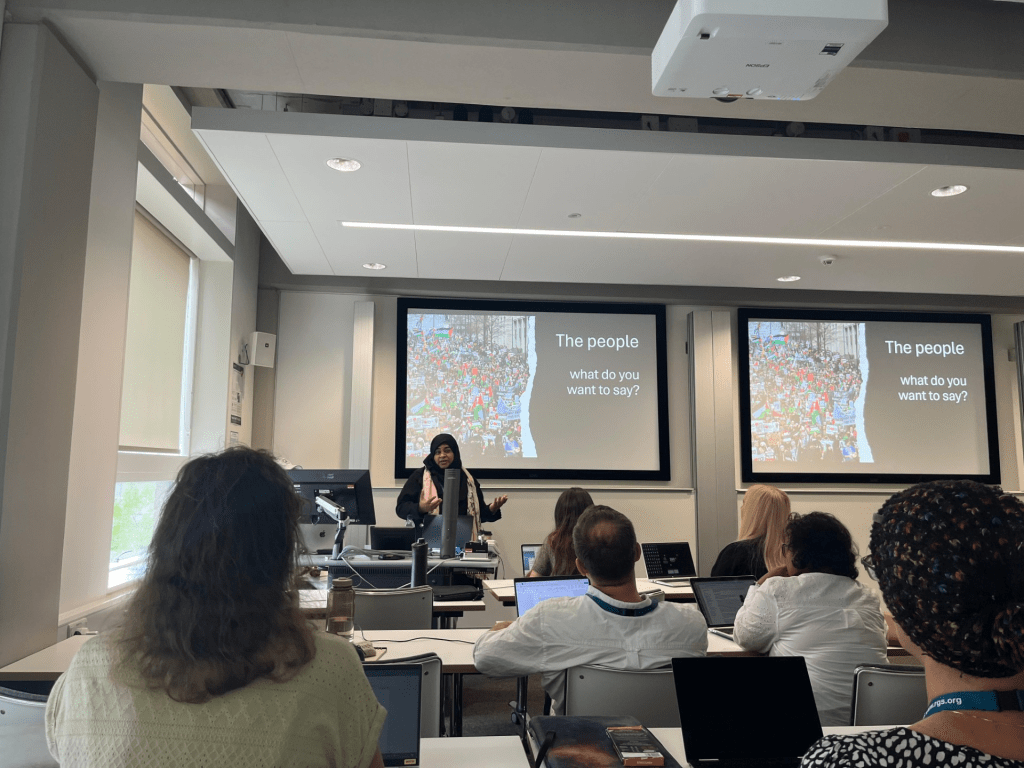
Image by Lyn Kouadio sent to Iram Sammar

Close to my heart was participating in the Pedagogy Café: Teaching and Learning (from) the Middle East and North Africa. A devoted team of scholars facilitated this heartfelt session: Professor Aya Nassar (Convenor, Discussant, Panel Chair Durham University) and Dr Muna Dajani (Convenor, Discussant, Panel Chair, London School of Economics), Dr Sasha Engelmann, Royal Holloway, University of London, Dr Dena Qaddumi, London School of Economics, and Dr Olivia Mason, Newcastle (Discussants). The Pedagogy Café created a collaborative space to explore the creative energies that had been shaping how scholars and educators taught and learned about the Middle East and North Africa. It resonated with the conference theme by foregrounding innovative pedagogical practices, liberatory curricula, and alternative geographies of knowledge that were being imagined and enacted in classrooms, communities, and online spaces.

Over the past year leading up to the conference, a renewed energy had circulated among scholars, educators, and activists committed to teaching and learning about the Middle East and North Africa (MENA). Palestinian spaces and circles, in particular, had been at the forefront of building free, critical, and liberatory curricula that resisted silencing and reimagined the academy’s relationship to the region. Inspired by these efforts, the Café convened a space to come together, share, and reflect on creative approaches to teaching and learning from and about the MENA region.

The initiative emerged from a moment of both urgency and possibility. On one hand, the increased demand for pedagogical resources highlights the difficulties many face when teaching geographies of the Middle East — difficulties amplified by political silencing, disciplinary gatekeeping, and structural inequalities within higher education. On the other hand, the imaginative work of educators and their allies had opened new pathways for curricula that were free, collaborative, and transformative. I hope to bring such discussions to the GA annual conference in 2026.

At the Café, we also held space for these ongoing pedagogical endeavors: showcasing how the geographies of Palestine have been affected by the ongoing genocide and scholasticide the whole world is witnessing – reflecting on the processes behind them, and reimagining their potential for reshaping geographical teaching and learning through criticality. Through short roundtable pitches, invited speakers introduced initiatives they had been part of — from online syllabi and open readers to community-based teaching projects. The conversation then opened up, creating room for collective discussion, troubleshooting challenges, and asking difficult questions about what it means to teach and learn MENA geographies today.

In foregrounding critical questions, the Pedagogy Café reflected not only on teaching practices in the moment but also on the connections between past and present struggles, and the possibilities for pedagogical futures centered on liberation, collaboration, and accountability. Ultimately, the Café offered an invitation to reflect on how we teach, to learn from one another, and to push beyond disciplinary confines toward more expansive geographies of knowledge.

These spaces are not without spontaneity, as Dr Gunjan Sondhi and Professor Parvati Raghuram in their session: Rethinking categories under attack: Creating responses, asked me to speak on the geographies of Palestine in the school context. Always ready to talk and share my thoughts, here I was given the space to speak freely with no inhibition or fear of being silenced. Gunjan talked about ‘confusing times’ and navigating how to rethink our categories and make them more expansive (Sondhi 2025) – whilst working to decolonise them. The presentations reflected on confronting ‘an intensification of the opposite, the pressure to erase categories that focus on power relations – migranticised, classed, raced, gendered, Anti-Seminitism and Islamophobia.’ The panel was captivating and focused on the challenge to inclusivity and expansiveness that are faced in the ‘contemporary conjuncture.’ They asked the following questions: Do we hide and smuggle those categories, abandon them, or confront the pressure to erase them? What does geography with its overarching concepts, such as space, time, environment, and landscape, offer us when rethinking categories? Again, I was left wanting to carry on listening to speakers, such as Angela Last, Agostinho Pinnock, Lea Haack and Jennifer Veilleux. We had a tremendous audience with great scholars who have influenced my own work, such as Tariq Jazeel.

As the conference came to an end, I attended a session convened by Dr Rita Gayle and Dr Colin Lorne. Rita posed some intriguing questions to get the audience engaged in a roundtable discussion to reflect on the possibilities of thinking with the archives of Stuart Hall and Doreen Massey ‘to help interpret and intervene in the troubling present.’ It was a mind-blowing session, where the whole theatre was engaged in breaking the silence and speaking up and to each other. We were asked to rethink how Stuart Hall and Doreen Massey’s work can be understood today, especially with some of the troubling far-right sentiments against immigration and marginalised communities, and the national rallies that were brewing during the time of the conference. There was a discussion on what the St George’s flags were symbolizing and how this impacted different communities living in Britain today. I had an interesting conversation with the Uber driver just before the session, who is local to Birmingham. He talked about how hard his father worked in the region in the 1970s and the difficulties he endured making a home in Birmingham. Due to anonymity, I won’t mention his name, but his heritage is Muslim Pakistani. One of his main concerns was the anti-Muslim and anti-migrant feelings amongst the far-right organisations and supporters. He said: ‘my main concern is getting people safely home or to places in and around Birmingham, so when they say we are dangerous (Muslim men), it makes me upset – we are the ones making sure people are safe at God-knows what hours at night! People coming back from clubs and people not knowing the place well – we are there to help.’
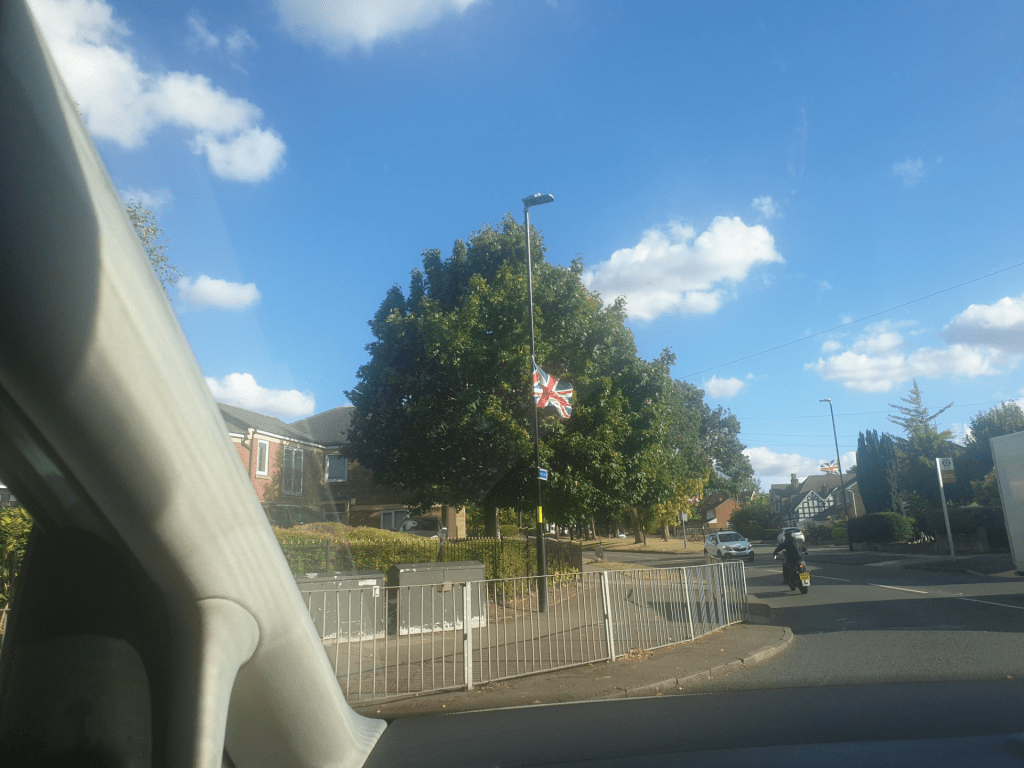
Like the friendly Uber driver mentioned, the meaning of the St George’s flags going up for my own Pakistani heritage parents during the 1970s and 1980s, was entrenched within racism and a sense of being ‘othered’ and often excluded (see blog). Driving in and out of Birmingham came with a visual display of patriotism and a clear message of incitement of community division. I am British-born – is this my flag too? My own son asked me: ‘Is England playing in a football tournament?’ Do I explain, or just let him innocently think of a possible brighter future, where your skin tone, religion, place of heritage, or migration status won’t define your belonging or existence? The session definitely kept alive the thinking with Hall and Massey about ‘what’s politically at stake today: not to find easy answers to the questions thrown up in the here and now, but to help think the many times and spaces of current conjuncture in all their complexity.’ Both these scholars operated as everyday people with everyday communities, whilst writing for the institution and speaking to power. Rita was engaging and taught us what it means to never forget our scholars who paved the way for us, newer scholars.

I could write more, and probably should, but for now, I hope you have enjoyed some of my reflections. There were a few nice places to pray in Birmingham University, which is always nice (see image below). A special heartfelt thank you and prayer goes out to Professor Pat Noxolo, for creating a space where we all came together and shared knowledge and ideas – felt seen, loved, and respected. Thank you for reading, and please do get in touch if you want to connect.
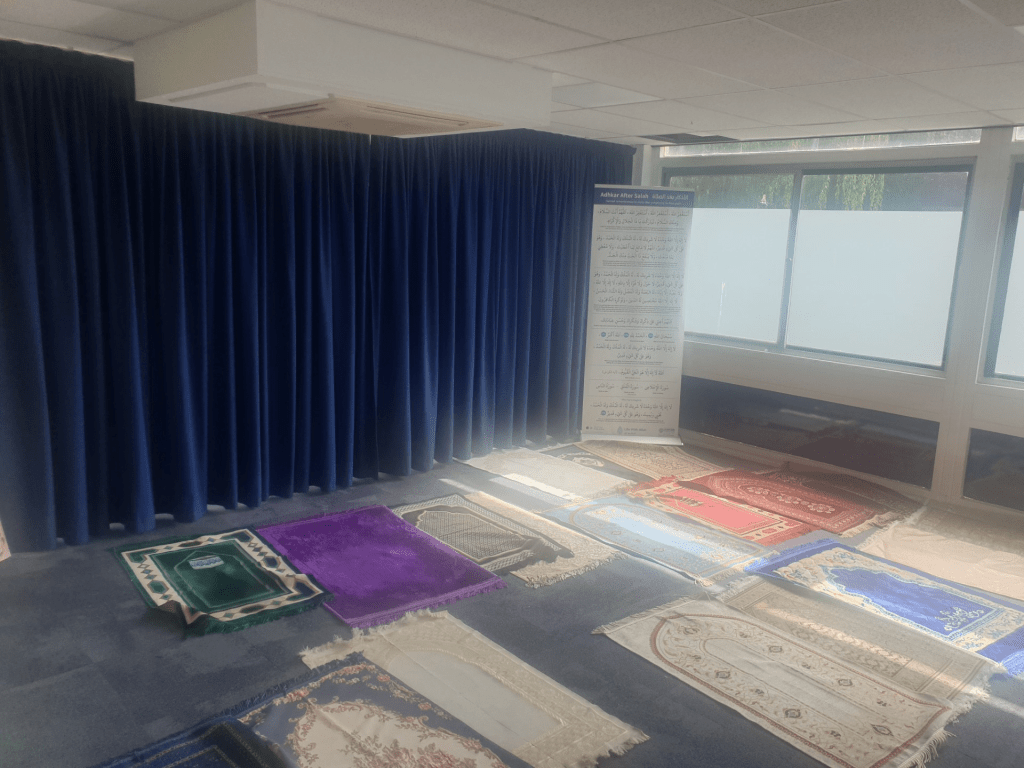
Image by Iram Sammar

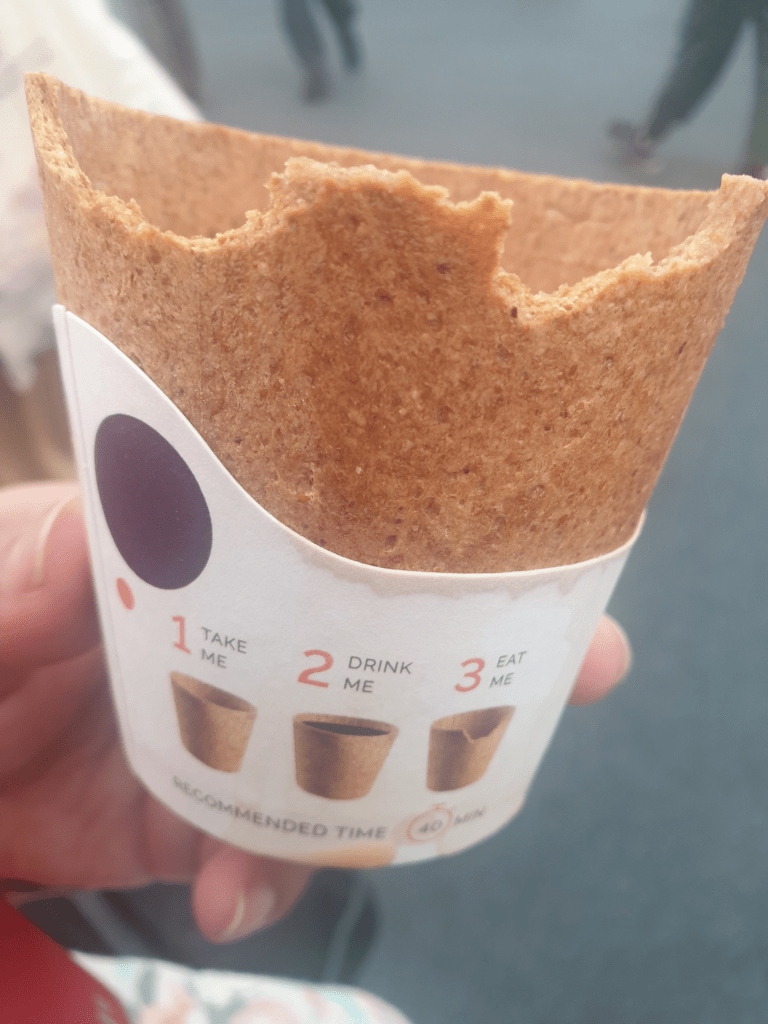
Oh, and I almost forgot – the edible cups. Have a bite!
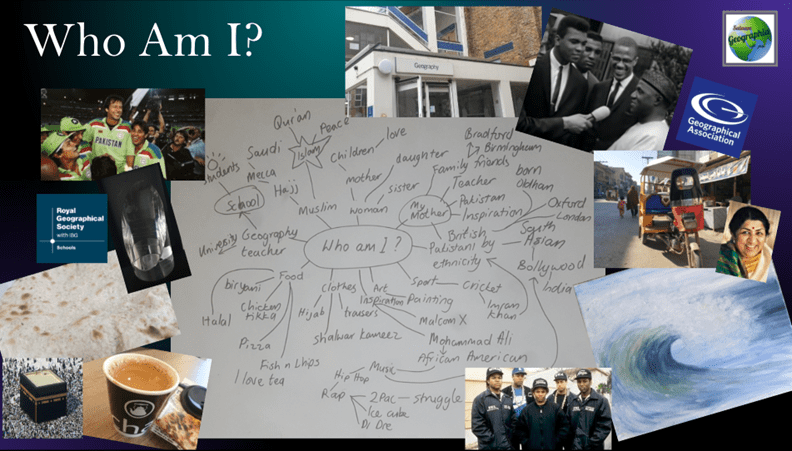
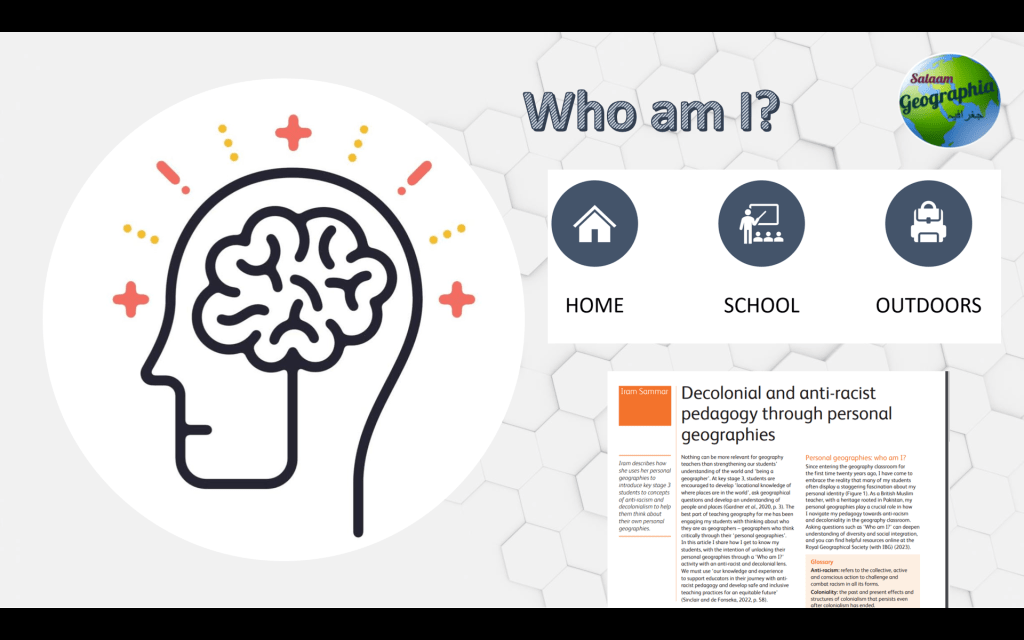
Get to know your students: Who am I?

[Download the full resource below]

Written by Iram Sammar

Date: Rabi (1) 10 , 1447 AH (September 2, 2025)

Getting to know students is not just a warm-up activity at the beginning of the year—it is an act of justice and care. Both Paulo Freire and bell hooks remind us that education is never neutral: it either reinforces systems of oppression or becomes a space of liberation. Freire’s Pedagogy of the Oppressed challenges teachers to see learners as co-creators of knowledge, not passive recipients. Similarly, bell hooks’ Engaged Pedagogy emphasizes that teaching should honor the whole person—their histories, identities, and lived experiences.

When geography teachers take time to learn who their students are, they signal that every learner’s story matters. This shifts the classroom away from domination and toward community, dialogue, and mutual respect. hooks reminds us that real education begins with care, presence, and vulnerability—teachers showing up as whole people, and making space for students to do the same.

A practical starting point is a simple “Who Am I?” resource. This tool invites students to share aspects of their identity, interests, learning styles, cultural backgrounds, and goals. It doesn’t have to be complicated—it could be a short reflective writing, a visual project, or even a guided discussion. What matters is the teacher’s willingness to listen deeply and to weave those insights into the fabric of the classroom.

By beginning with “Who Am I?” and returning to it throughout the year, teachers enact the engaged pedagogy hooks describes: one where students are seen, valued, and empowered to participate fully in their own learning.

Further reading

Sammar, I., 2024. Decolonial and anti-racist pedagogy through personal geographies. Teaching Geography49(1), pp.22-25.

Download the Who am I? resource below

The Peak District: Reading the Landscape

Image by Iram Sammar

Written by Iram Sammar

Date: Dhu al-Qidah 22, 1446 AH (May 20, 2025)

(The Hijri date today is Tuesday, 22 Dhu al-Qidah 1446 in the Islamic calendar. Using the Gregorian calendar, the date is May 20, 2025)

One of my favourite topics to teach at Key Stage 4 (or GCSE) has been Distinctive Landscapes. Whilst many colleagues found this quite tricky, and as one colleague put it, “I prefer the students to experience a landscape,” I would use this as an escape from the urban strain.

How a trip to Sheffield led me to explore the Peak District

SHARE invited me to speak at their amazing conference “Revealing hidden histories and geographies of empire: what demands should we make of our education system?’ Speakers included Abtisam Mohamed – MP for Sheffield Central, Alan Lester – Professor of Historical Georgraphy, University of Sussex, myself, and Sheffield Museums, Roots & Futures and Sheffield Anti-Racist Education. A blog in itself to come on this. After the event, I treated my family to a “walking trip” to the Peak District. Surprisingly, I had never been before.

Sheffield, in itself is a city known for its industrial roots and creative energy, and it sits right on the edge of a UK landscape treasure—the Peak District. We had the car, so the national park was just a short drive away. My children did not know what they were going to experience, so it would have been almost criminal not to escape the concrete and lose ourselves in the wild beauty of the hills. If you’re a student looking for a weekend walk, an urban dweller needing a breather, or just visiting the Steel City, the Peaks are a must, so get your hiking boots on!

Throughout my journey studying geography, I have felt the countryside to be a “white space”—a place imagined and experienced as predominantly white, rural, idyllic and often exclusionary. All those wasted years, I saw the rolling hills and quiet lanes, a place to speak a language of a certain kind of “belonging” that couldn’t speak to me. But that’s beginning to shift. Across national parks, including the Peak District, a pleasant array of diversity is visible, more Black and Global Majority presence, lot’s of young urban explorers, and diverse communities are enjoying these magnificent spaces within these landscapes. From grassroots walking groups to inclusive outdoor festivals, the countryside is slowly becoming more representative of the nation it surrounds—proof that the outdoors defies exclusion as it belongs to no one, but everyone. Many walkers would stop and say, “Hi, not much longer to the wonderful view over by the giant rocks.”

As Abtisam strongly stated, we are not “an island of strangers,” rather:

“We are a mosaic of neighbours, friends and families from across the world. We all cooperate and contribute to our community. Our country was rebuilt from the contribution of successive generations of migrants, like my grandfather and father who worked tirelessly in the steel industry. They were not strangers, but part of a city and country that welcomed them.”

It is important to hold space and celebrate the true meaning of community in its diversity and inclusion, where difference is seen as a way of knowing and getting to know one another.

Ladybower Reservoir

Image by Iram Sammar

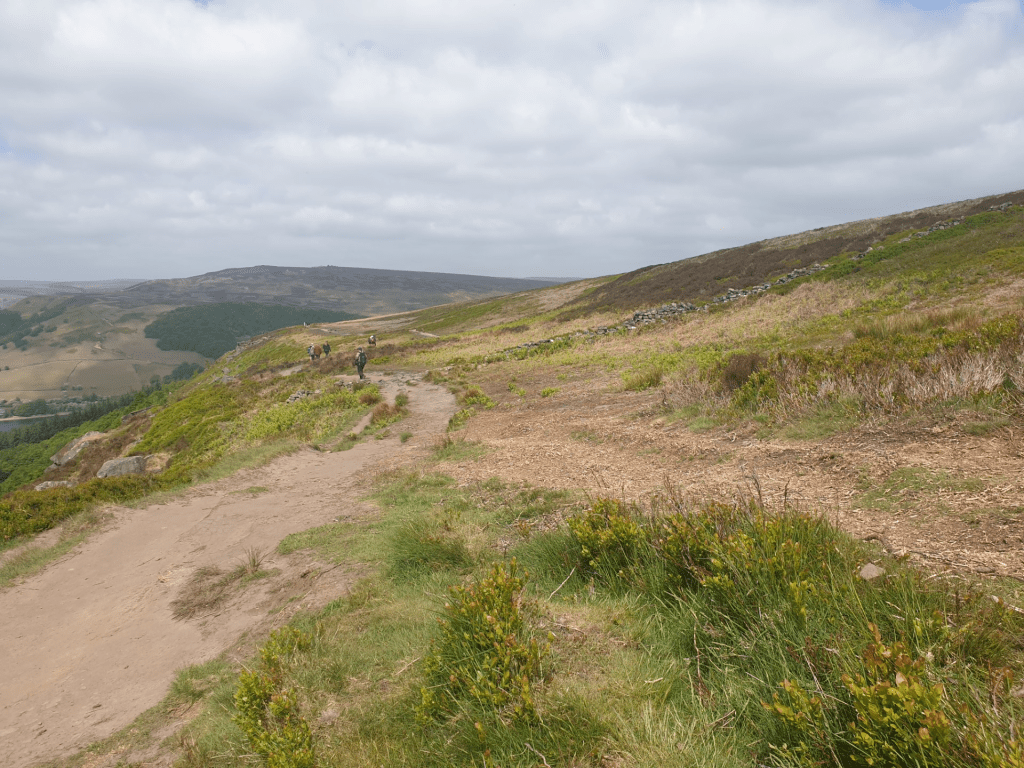
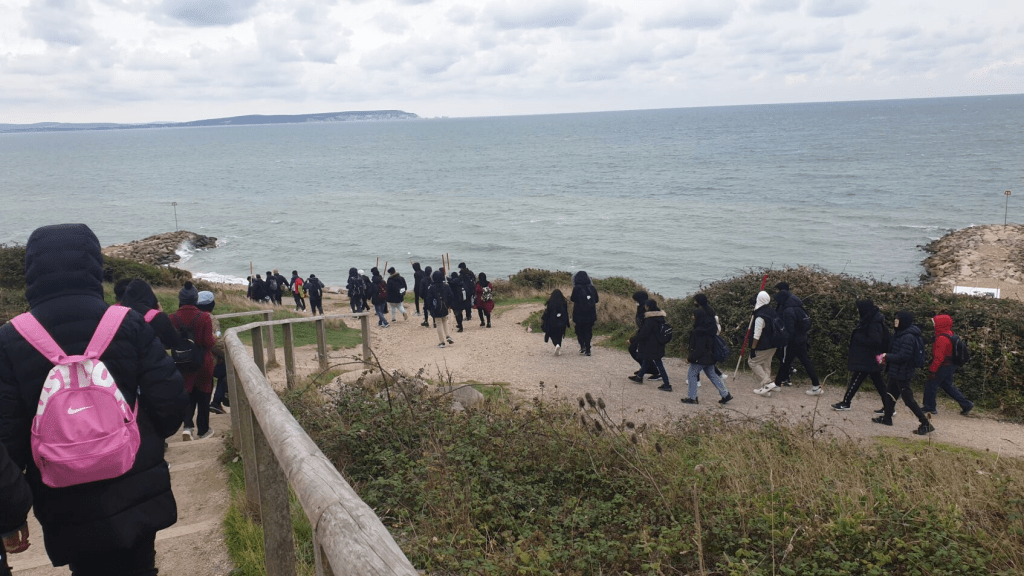
Walking up to get an ultimate view of Ladybower Reservoir was something quite of an adventure. After a lot of scrambling and tripping up over loose rocks, we made it – of course I was the last in the family to reach the viewpoint above Ladybower Reservoir. There are fresh natural springs, streams, and trickling water sources on walks in the Peak District, especially where we went. The area is rich in natural features due to its geology—particularly in the White Peak (limestone country), where underground water systems often surface as springs. We only had time to visit Ladybower Reservoir, so you can definitely encounter springs, streams, and flowing water, especially if you take one of the more elevated or woodland routes. The whole area is part of a scenic, lush, upland catchment, where water flows naturally through the hills, especially after rain. This stunning walk takes you through areas with natural springs and upland streams, particularly as you go down toward Rowlee Pasture, or cross through moorland areas. It’s a tough route, but water is often visibly bubbling up in places where you find lots of peat and mossy ground. As you head uphill from Ladybower toward the rocky escarpments of Derwent Edge, you won’t find large springs, but there are smaller streams fed by moorland runoff. A lot of this is seasonal, so dependent on rainfall.

Image by Iram Sammar

It wasn’t easy, let me tell you—it was steep, uneven, and seemed to go on longer than expected! I kept soldiering on, regardless of the wind picking up speed and trying to topple me over. An amazing path is carved out conveniently for the hikers, where there are parts extremely narrow near the top. Your legs will burn, your conversations will fade into gasping silences. One thing is for sure, the oxygen your lungs will inhale will keep you motivated to keep on going. Fresh air. Many times, you will think to yourself, “turn back, you’ve seen enough beauty.” But then, you will meet a couple, or some friendly hiker walking their dog, encouraging you to keep going. When all of a sudden, “Oh, SubhanAllah”, the trees will clear, and there you will see it: Ladybower stretching out like a shimmering mirror, reflecting the beautiful sky in its surface, embraced by breathtaking rolling hills of the Peak District. “Ma’ Sha Allah,” it was worth it, but as I write this, my legs and feet are still killing me! I promise the exhaustion will melt into awe. This struggle gave the view something beyond beautiful, it felt like winning a medal, where nature cheers you on, and the rocks stay still in their silent caress. On our walk back down, there was an opportunity to pray Zhur salah, which is the midday Islamic prayer. Therein, hidden within the veil of the woods, was the perfect surrounding to attain Khushu (attentiveness and tranquility in prayer). Praying in the outdoors has its own sense of serenity. We drove home with contentment and inner peace (sorry for sounding like the Kung Fu Panda!).
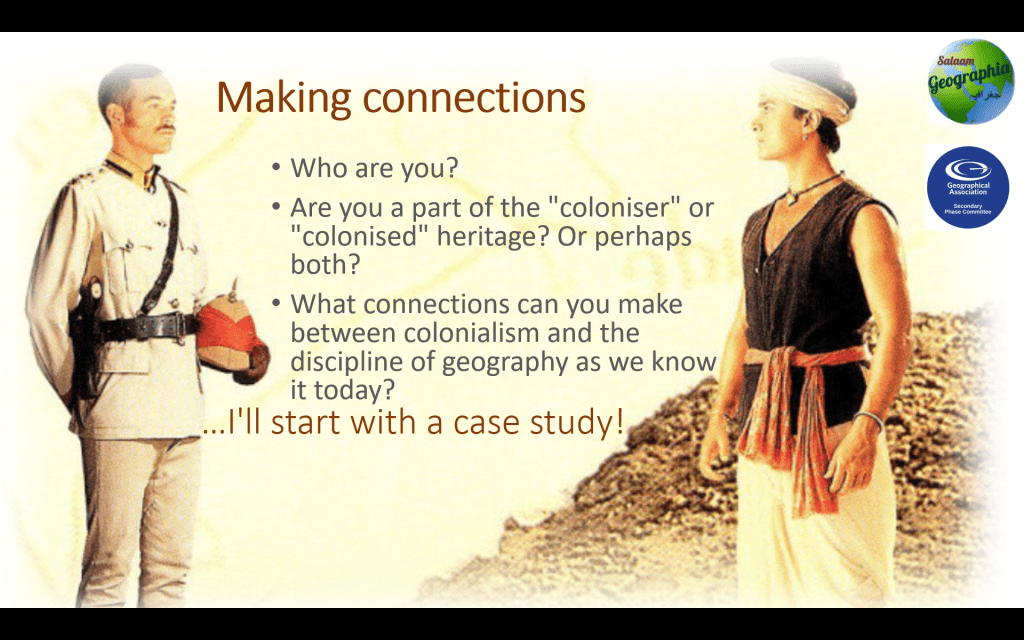
Image by Iram Sammar

Enough of the poetry, let’s get into the geography. When describing landscapes, I quite like getting the students to use the diagram from OCR GCSE (9-1)Geography B: Enquiry Minds (Figure 6, Rogers 2020, et al. p. 63). It shows the many different elements that make up a landscape. When you get your students to a location such as the Peak District, get your students to close their eyes and recall what they saw walking up and in front of them. They can discuss which elements they can see using the landscape wheel below.

How can we read the landscape?

“An important part of any landscape is the shape and height of the surface landforms that can be seen. A landform can be defined as ‘any physical feature of the Earth’s surface which has a characteristic, recognisable shape and is produced by natural causes’. Landforms help provide the overall character of a landscape, as well as affecting its soils and climate and the ways in which people use it.”

Coles, Jo; Payne, Jo; Parkinson, Alan; Ross, Simon; Rogers, David. OCR GCSE (9-1) Geography B Second Edition (Ocr Gcse 9-1) (p. 182). Hachette Learning. Kindle Edition.

Next time, perhaps you can get your students to write a blog on their physical geography field trip. I would love to hear about it. Personal experiences, like the ones I have shared with you, get you thinking about landscapes in rich and meaningful ways. Bringing out the geography is sometimes difficult in words, but using some phrases you say during the trip and recording these gives a sense of place to the reader. Those initial feelings and words that come out embody the whole experience.

What physical landscapes of the UK have you visited?

Where would you like to go?

One for me: Where do you think I should visit next?

I hope you have enjoyed reading this as much as I have enjoyed the writing. Thank you and, until we meet again, PEACE.

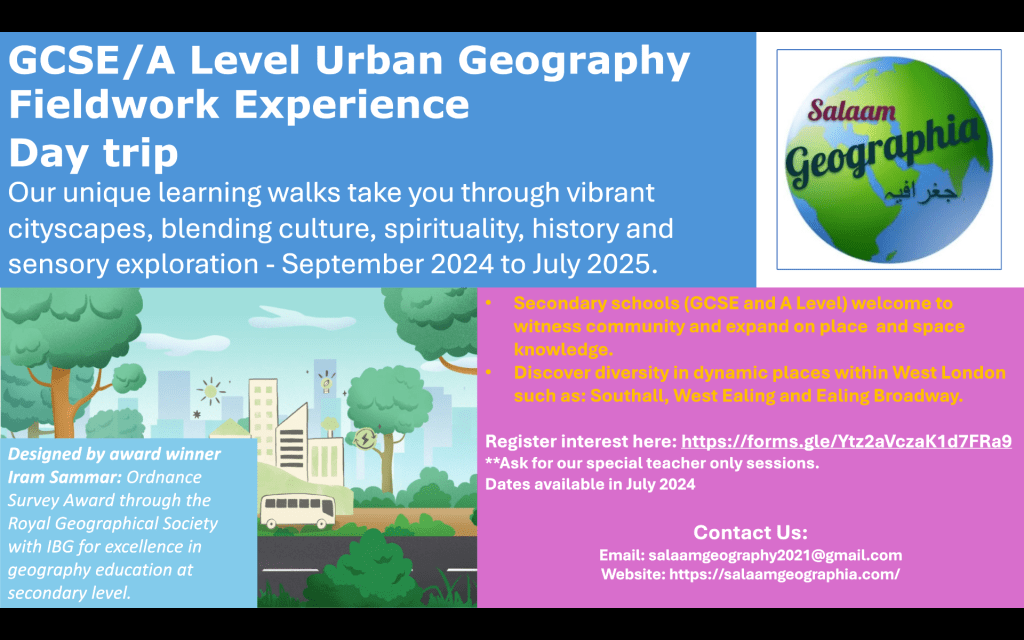
SG Launching: GCSE/A level Urban Fieldwork Experience

Welcome to Salaam Geographia’s GCSE/A Level Urban Fieldwork Experience, where urban fieldwork in London becomes a transformative experience for you and your geography students. Our unique learning walks take you through vibrant cityscapes, blending culture, spirituality, and sensory exploration. Engage deeply with the city’s diverse communities as we delve into antiracism and decolonial narratives, uncovering hidden histories and fostering inclusive understanding. Through these immersive journeys, participants will not only explore the urban environment but also develop critical perspectives on social justice, enriching their geographical knowledge with profound, lived experiences. Join us to see London through a new lens and walk the path toward a more equitable future.

GCSE (and A Level) Urban Geography Fieldwork Experience

Day trip

Our learning walks will take place for students from September 2024 to July 2025.

Launching a new fieldwork experience: ‘Unveiling Southall’s Diverse Urban Tapestry

  • Secondary schools (GCSE and A Level) welcome to witness community and expand on place and space knowledge. 
  • Discover diversity in dynamic places within West London such as Southall, West Ealing and Ealing Broadway.

Register interest here: https://forms.gle/Ytz2aVczaK1d7FRa9

**Ask for our special teacher-only sessions. 

 Dates available in July 2024

Read related blogs:

Gentrification in London: Decolonising Urban Fieldwork

….just ‘feel the vibe’ of the place

Written by Iram Sammar

Date: Dhul-Hijjah 01, 1445 AH (07 June 2024)

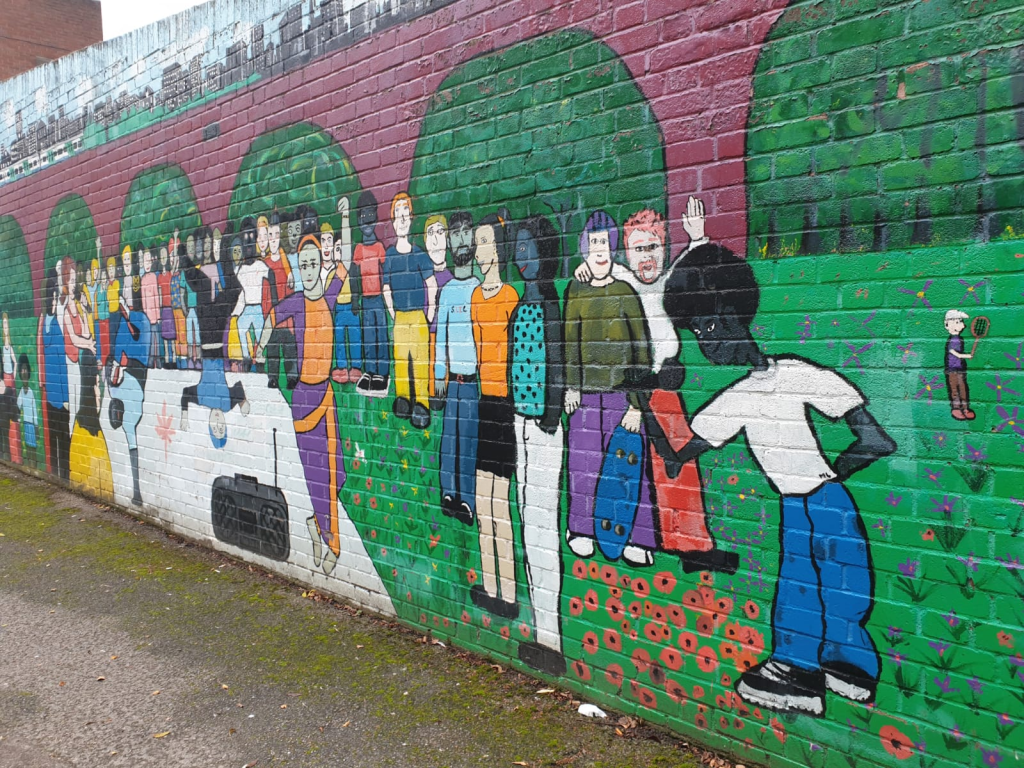
The image above was taken spontaneously by me in West Ealing, London a few years back – the mural no longer exists as it has been sealed off by a brick wall through a construction company engaged in the process of regeneration. Regeneration and gentrification are terms often used in understanding urban change or discussions about developing place and the altering nature of space – regardless, they refer to different processes with serious implications for the people and communities affected by such changes. So much geography is going on the picture. What questions do you have? It was a fantastic piece of artwork, which embodies the community that once thrived here (or perhaps it still is thriving?), but the mural no longer exists. What is the story? For those unfamiliar with the area, here are some inquiry questions:

Where have the people gone?

Who benefits from gentrification?

Did lives improve?

Who made the important decisions?

Who had the power?

Urban fieldwork is an important component of geography education in England, United Kingdom at GCSE and A Level, providing students with firsthand experiences that bring theoretical concepts to life. This article will demonstrate how decoloniality and antiracism can be embedded into the learning experience to improve how students navigate the field, especially in places across the UK. Recently, I had the opportunity to join Izzy Wood and her A Level class from Alton College on an eye-opening field trip to Elephant & Castle and Brixton in South London, focusing on the often-overlooked Latin American community and the rich Black British History of the area, courtesy of the Black Cultural Archives and Latin Elephant. This trip was not only educational but also an opportunity to self-reflect and learn more about this vibrant area and the journey of resistant communities through their struggles and triumphs. So it is not surprising when Izzy Wood got in contact, I jumped at the chance to experience this rather special fieldwork she has been engaging her students in for quite sometime.

Understanding Gentrification: An Introduction

OCR definition: Gentrification – process by which former low-income inner city housing districts in AC (Advanced Countries) are invaded by higher-income groups and refurbished. (Hodder textbook)

Most exam boards in the UK define gentrification within the context of geography education as the process and study of urban spatial change in which wealthier communities and organisations move into, renovate, and rejuvenate previously ‘less’ affluent urban areas. Such change often impacts rising property values and rent, which can displace long-term, lower-income residents. We often end up teaching gentrification largely through a neoliberal lens. This could involve ignoring race, ethnicity, and other characteristics that make up the demography of a particular area, because focus is placed on economic principles and individual actions, with little or no reference made to wider social and historical contexts that affect different groups of people.

Teachers may focus largely on economic changes through developing an understanding of how investment in property and infrastructure by wealthier newcomers affects local economies, job markets, and housing affordability. This may lead to the discussion of some social and cultural impacts as students are encouraged to analyse the shifts in the social fabric and cultural identity of local area as new populations move in and original residents are ‘pushed’ out. Another common aspect of gentrification is studying urban development and planning to investigate how urban policies and development projects facilitate or mitigate gentrification, including the role of government and private developers. This may lead to understanding spatial patterns through mapping the geographic patterns of gentrification, which may include looking at areas most susceptible and how these patterns change over time. Environmental justice might be explored by examining how gentrification affects access to resources, green spaces, and the overall environmental quality of urban areas, which has intersectional links with issues of racial and economic inequality – but how this might be approached differs from school to school. No GCSE and A Level learning is without case studies, where delving into specific examples from cities around the world, particularly from those places considered to be ACs, although classifications within themselves must be critically assessed too. All this together develops a student’s understanding of the local nuances and broader trends of gentrification. Students and teachers may use tools such as Geographic Information Systems (GIS) to visualize and analyse the spatial dynamics of gentrification. Through qualitative methods, such as interviews and ethnographies teachers can gather deeper insights into the experiences of impacted communities. So, it is important to ensure sensitivity within such fieldwork, which involve approaches that prioritise the dignity, privacy, and cultural values of local communities. Although teachers may have these conversations in the classroom before heading off to a new place – these should continue on the field too. In the context of geography education in England specifically, this blog will explore how an added decolonial and antiracism lens could bring a more nuanced approach to examining gentrification with London as a case study. The study of gentrification is vast and has the potential to raise awareness of the complexities of urban change which equips students with the critical skills to assess and acknowledge its wider impacts on the communities often ignored.

A Fieldwork Journey with Izzy Wood and

Alton College Students

Exploring Gentrification and Cultural Identity in Elephant & Castle and Brixton: A Learning Walk with Izzy Wood and Alton College Students

Part 1: The Invisibility of the Latin American Community

One of the striking realities Izzy focused on during our trip was the ‘invisibility’ of the Latin American community in the UK. The first part of our learning walk with Valerie Rosa took us through a captivating guided tour of Elephant and Castle to address how despite the significant presence of the Latin American community, they are not recognized in the UK census, where their contributions and challenges are often overlooked. Valerie is a committed member of Latin Elephant, an organization dedicated to empowering ‘Black and minoritized Londoners to engage in processes of urban change.’ Such invisibility has tangible impacts, from underrepresentation in policy decisions to the erasure of cultural identities in broader societal narratives.

Valerie talked about a shopping centre which was demolished in 2020, ‘but this was not without a fight,’ as these communities alongside Latin Elephant and other local groups made demands for refurbishment. This shopping centre was at the heart of the migrant and Latin American communities in the area, so the demolition was heartbreaking, as the livelihood and hard work of those displaced were all taken away in the name of regeneration. Although Valerie emphasised that ‘no one is against regeneration,’ the wider process of gentrification has meant communities like her’s were overlooked and ignored in the decision-making process. Valerie shared her lived experience which made the learning valuable for the students as they were exposed to the harsh realities of gentrification through an authentic voice from ‘within a community.’ Sivanandan often made reference to how communities marginalised in the UK should have the opportunity to resist erasure and racism and such discussions are clearly relevant today.

Next time you plan a field trip to the area, be sure to get in touch with Valerie. She is a warm and genuine person with engaging presentational skills – Alton College students really appreciated her insights and were captivated throughout.

Image by Iram Sammar of Valerie Rosa
Part 2: Black Cultural Archives

Hannah’s fantastic workshop is a must for any school looking to expand their knowledge of Black British History – it is presented in a unique and inspiring way through digital timelines and various artifacts. The Black historical timelines are proudly presented through a prestigious partnership between the Black Cultural Archives and Royal Holloway, University of London. This significant five-year collaboration is dedicated to making the teaching and learning of inclusive, shared histories and is fully accessible for schools and colleges. They use an impressive array of documents and artifacts from BCA’s unique archival collections, many of which have been meticulously digitized, this initiative does well to broaden access and enhance understanding on a global scale. Hannah had a fantastic rapport with the students and kept everyone engaged through clever questioning techniques and reflections. See the images below. I have decided to not reveal too much in this article as it is important to experience this workshop yourselves with your students – highly recommended. For those of you wondering where to begin on your journey into decolonising the curriculum or establishing an anti-racism approach to pedagogy, Black Cultural Archives is most definitely the best place to start.

Following the workshop, we continued on our guided walk tour as Izzy talked to her students about important developments such as the Brixton Square development and Clifton Mansions. With the rise of gated communities, Izzy helped students imagine what life was once like, where the area thrived as a dynamic hub for ‘musicians, artists, squatters, idealists,’ the marginalized, and a colorful array of people who created their own vibrant community (see Brixton Buzz). On our walk, we passed stunning artwork like the mural at the beginning of this article – from images of George Floyd and Marvin Gaye to Palestinian solidarity writings on the walls. It was clear a story was unfolding, one which you will not find in any geography textbook

There was a moment, in the pouring rain during our tour of Brixton, where I asked the students to close their eyes and just ‘feel the vibe’ of the place – to listen to the sounds and take in the scents through their senses. We heard Reggae beats, appreciating the music’s unique rhythm, we felt the deep connection it had with the community we were privileged to experience. Reggae’s distinctive offbeat rhythm evoked a relaxed and emotional vibe. When I opened my eyes, I witnessed the soothing and uplifting sensation I truly believe we all were feeling unanimously – I can say, it was quite emotional, especially as we had just attended the brilliant workshop with Hannah earlier. The students were encouraged through their senses to question and critique dominant narratives that portray gentrification as purely positive urban revitalization, instead of examining the socio-economic and racial displacement it often causes.

This field trip reaffirmed the immense criticality of decolonising fieldwork in geography education. It highlighted that experiencing a place firsthand and appreciating the cultures and diversity within, can evoke empathy, challenge preconceptions, and inspire a meaningful understanding of complex social issues. By stepping away from classroom, textbook and specification constraints, students had the opportunity to appreciate the streets of Elephant & Castle and Brixton. Izzy’s students gained invaluable insights that no textbook could provide.

Image by Iram Sammar
Image Iram Sammar: Resources from the Black Cultural Archives workshop
Izzy Wood: Personal and Emotional Connections

For Izzy, this field trip was more than an academic exercise. It was a journey through a place she once called home, filled with memories of shared meals, community events, and personal connections. She was able to do this by bringing learning to life with this walking tour. No worksheets, no fuss, just the students and their senses. The loss of cultural spaces and displacement of long-time residents due to gentrification in Elephant & Castle is a deep personal loss for Izzy too, so it was a key theme she conveyed to her students.

Izzy mentioned how understanding that students from a rural village in Hampshire might struggle to grasp the complexities of urban gentrification through textbooks alone, so she organized a walking tour with presentations from Valerie (Latin Elephant) and Hannah (Black Cultural Archives). This immersive experience allowed them to see and feel the contrasts and changes in real time. The reaction was profound; one student remarked it felt like being in another country, while another expressed sorrow for the displaced community; and one student found joy in seeing a part of the UK where the Black and Global Majority were represented.

Image taken by Iram Sammar
Image by Iram Sammar: Izzy Wood in conversation with Valerie Rosa

Izzy’s own reflection:

“In planning the A Level content, I noticed a gap. Much of the curriculum focused on areas like Brick Lane and East London, while my knowledge and experience lay with the Caribbean and Latinx communities in South London. To bridge this gap, I curated resources from various platforms, including the Brixton Buzz, Latin Elephant website, and YouTube channels, alongside social justice campaigns shared by my Colombian friends on social media. This comprehensive approach ensured that the materials were rich, diverse, and reflective of the lived experiences of these communities. As the Latin American community is not recognised in the UK census they have been ‘invisible’, so I thought it was time to write about this and start in my classroom with my students. This is also a place I lived for over a decade and knew the community, the food, the place really well so a lot of the loss in Elephant… is personal and it is part of my personal geography. I built the resources up using a lot of content from the Brixton Buzz, Latin Elephant website and YouTube channel as well as plays, social justice campaigns I saw my Colombian friends post about on social media etc. I teach gentrification in Elephant & Castle in changing places and Brixton in social segregation, cultural diversity, economic inequality for contemporary urban environments for the AQA A level spec. In this section, I taught the history of racism & anti-racism in London and added quite a lot of decolonising and life lessons to a section which could just as easily be interpreted as a racist or right wing section of the spec, particularly based on what is in the textbook. Eventually, I put it together as a walking tour for my students because I realised as students from a village in Hampshire they just can’t imagine it even with videos and pictures and accounts it’s a world away from their lived experience. One student even said he felt like he was in another country because he didn’t know the UK could be like this. I bought Colombian snacks from Distriandina for the students to experience as I knew the trains were delayed around Elephant to Herne Hill. This gave me time to speak to them individually about their reaction from the classroom to real life and one student said they just felt really in despair and sad for the displaced community, another from the Philippines said they had assumed the UK was all white like our village and was happy to see areas where the global majority were dominant. This gives me confidence that the reason we take students into the field is worth it because you just can’t imagine places. “

(Izzy Wood, 2024)

Izzy’s exploration and endeavour were rooted in the AQA A level specification, specifically looking at gentrification in Elephant & Castle under changing places, and Brixton for social segregation, cultural diversity, and economic inequality in contemporary urban environments. Importantly, she integrates lessons on the history of racism and anti-racism in London, adding a decolonial perspective that challenges the potentially biased narratives in standard textbooks. This approach has transformed the learning experience for her students, making it more inclusive whilst raising social awareness.

To deepen their cultural immersion, Izzy kindly purchased delicious Colombian snacks from Distriandina. This not only provided a welcomed break from the delayed trains but also facilitated individual conversations about their experiences and reactions. These discussions revealed a range of emotions, from despair over displacement to happiness at seeing diverse communities thriving. One students expressed how “coming to a place and feeling the culture is really important and to know there is a world out there beyond your own.”

Final thoughts: Decolonising Urban Fieldwork

As educators, our goal is to broaden students’ horizons and equip them with the tools to critically engage with the world. This fieldwork experience did just that, leaving a lasting impact on the students and reinforcing the importance of connecting classroom learning with real-world experiences. Teaching gentrification with a decolonial and antiracist lens in geography education should involves a critical examination of the power dynamics, historical contexts, and systemic inequalities that are connected to the phenomenon. There are numerous methods geography teachers can use whilst out in the field. Firstly, it is important to explore the historical context and the colonial legacy of urban development – how have these histories shaped contemporary spatial inequalities? This could lead on to a discussion of how colonial legacies continue to affect urban planning and land use policies. When choosing case studies, teachers can include information that trace the lineage of gentrification practices to colonial dispossession and urban renewal projects that disproportionately affected marginalized communities. Izzy’s learning walk included pedagogical approaches that de-centre Eurocentric knowledge and prioritise Black, Global Majority, Indigenous and local knowledge(s). She incorporated authentic community-based research methods and asked decolonial and anti-racism thinkers to contribute to the development of her learners’ understanding of race and racism. Engaging students in projects that involve collaboration with local communities affected by gentrification, fosters an ethic of solidarity and social justice. I would also like to highlight, when conducting fieldwork in areas where people might feel you are intruding with your gaze, it is critically important to be sensitive and respectful. People and communities deserve to have their dignity respected. Intrusive behaviour was discouraged, such as staring or taking photos without permission, as this can make people feel objectified and humiliated.

I would like to take this opportunity to thank Izzy, Julia (Izzy’s colleague) and most of all their students from Alton College for an amazing experience – peace and power to the communities we visited.

Have you planned fieldwork in your school where you have thought about anti-racism, decoloniality, or social justice? I would love to know more, or feature it here at Salaam Geographia, so please do get in touch: salaamgeography2021@gmail.com.

Thank you for taking the time to read this blog.

GA Annual Conference 2024: Reflections and Insights

GA Annual Conference 2024: Reflections and Insights

We live in a world where the reproduction of eurocentrism, colonialism and ‘whiteness’ still unnaturally pierces through our educational systems, therefore the importance of decolonising teaching practices are evermore important.

Written by Iram Sammar

Date: 29 Ramadan 1445, AH (8 April 2024)

This year the 2024 Geographical Association Annual Conference and Exhibition, has been one to remember, where many decolonial ideas and praxis have found their way into mainstream geography education. Two years back I shared my classroom stories and the Bus Ride Home: ‘Go back to where you came from’ (click to watch the whole Teach Meet for 2022) where I explored ideas about decoloniality and what it means to be an antiracist geography teacher. Since, I have celebrated a published article titled, Decolonial and Antiracist Pedagogy through Personal Geographies. This year, Denise Freeman’s presidency saw an important theme manifest into an important collection of ideas and collaborations to continue these transformative methods and strategies. With the intention of diversity and inclusivity, the presidential theme Geography for Everyone proved to be a successful one. This blog is a reflection to highlight largely my own key takeaways, so any critique and complements are subjective to the lens from which I view things – yes, decoloniality and antiracism at the heart of the experience.

Acknowledgment from Denise Freeman, GA president

Geography for All: Navigating Spaces as a Muslim

“In the World through which I travel, I am endlessly creating myself.”

(Quote from Frantz Fanon)

There is a stark reality that, despite the increasing consciousness and observance of diverse voices within geographical spaces in the UK, the dominant narrative and mainstream audience often remain predominantly reserved for ‘whiteness’. Fanon’s quote above reflects the difficulty of navigating a society, that isn’t designed for you. This reflects the absence(s) of representation, which can enforce barriers for marginalized communities, such as in this case Muslim geographers, who may struggle to navigate these spaces and to fully engage in such events. Again, it is a reality that forces us to confront the fragile balance of inclusion and exclusion, where sometimes, regardless of our greatest efforts, there are always some voices inadvertently sidelined or erased from these spaces.

In hindsight, there is a resilience that manifests from the faith of Islam itself, in my commitment to critical thought and inner peace, I valued sharing my presence at the conference. It felt as though I embodied a physical recognition that, as a Muslim woman, I can (and will) navigate a world where someone like me must sometimes ‘win some, lose some.’ There is is big ‘however’, that again another reminder of the critical awareness of our presence as Muslims (and) women, the acknowledgment of the value of our commitments and contributions to the wider debates and discourse in geographical education as addressed by the late Dr Azeezat Johnson (may Allah ﷻ grant her a high status in Jannatul Firdous, or Heaven). I have not even begun the intersectional elements of my own identity that are rooted in South Asia, the Global South; or the Indigenous privilege of belonging to peoples of ancient Al-Hind; or modern (post)colonial era India; or emerging decolonial era, Pakistan. Born and raised in the urban struggle of the UK context, where Tupac Amaru Shakur reminds us of the urban rose, breaking through the barriers of concrete systems – not designed with me and my intersectional identity in mind.

I chose to attend the conference for a number of reasons, but I must confess, it was more about embodying my intersectional identity within a space I felt alienated in. As Frantz Fanon eloquently stated, ‘each generation must, out of relative obscurity, discover its mission, fulfill it, or betray it.’ In echoing the sentiments of bell hooks and el-Hajj Malik el-Shabazz (Malcolm X) and decolonial thinkers before us, I am reminded of the imperative to confront systems of oppression and to assert our presence in spaces where our voices deserve to be heard.

As Ramadan Kareem graced Muslims around the world, it was also the third consecutive year of the GA conference where both dates contended. It really was with intense consternation I approached the conference. Although the spirit of the blessed month indulged me with tranquility, gratitude and reflection, I could not contravene the disappointment of being fully aware that many of my fellow Muslim geographers were unable to attend. In all honesty, there were moments when I contemplated whether I should attend or be there at all. Guilt, as I feel as ‘if’ I could have been engaging with worship in the last ten days of Ramadan Kareem whirled in my consciousness. As I grappled with my spiritual constellation with this blessed month, I also had the desire to share that sentiment with fellow comrades in the Decolonising Geography Collective who came to the event, and the many friends within the geography community.

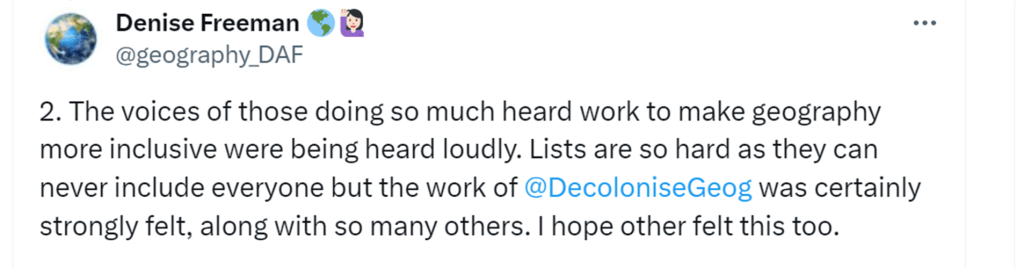
Attending the conference was not only about professional development for me, or the amazing networking opportunities; it was more about embodying my faith and representing the diverse community to which I belong – a community that is often marginalized or overlooked in academic spaces. Ambalavaner Sivanandan founder of the Institute of Race Relations once was quoted to have said, ‘We do not speak to, but from’ (quote selected by Gary Young cited in Communities of Resistance). I feel this quote resonates with the whole perception that although there are allyships and comradeships for marginalised communities to seek refuge in, real change only comes ‘from’ within a community or peoples going through oppression of some sort. Taking from the sentiments of bell hooks and el-Hajj Malik el-Shabazz (Malcolm X), I am reminded of the imperative to stand before and confront systems of oppression and to (re)assert ‘our’ presence in spaces where our voices need to be heard. As Dr James Esson eloquently reminded us in his soul-nourishing keynote lecture, ‘it is disrespectful to those who came before us’, to not acknowledge all the contributions to the discipline of geography and our knowledge(s) that shape how we might think and where we find ourselves in knowledge production in the present. A beautiful keynote lecture, by a beautiful soul. To see Salaam Geographia alongside the Decolonising Collective and Dr Joanne Norcup’s crucial revival of #CIGE the ‘global movement of educators, researchers, students & artists #DawnGill inspired’, made me hopeful. Joanne points out that although people were aware, knew of, and engaged with materials from the 1980s courtesy of the GLC & ILEA anti-racist inspectorate, she still spent ‘a decade recovering dispersed archives & writing/publishing is more than “collating” #citeright #histgeogsantiracism project.’ See Geography Workshop for the CIGE online materials. It was heartening to read Steve Brace’s post on acknowledging the body of work that already exists, as highlighted by James (see a post on X retweeted by Hermione). As Steve embarks on his journey as the new CEO of the Geographical Association, it is refreshing to be ‘seen’ and ‘heard’ by those comrades in powerful positions making time to speak to and involve people like myself. Steve took the time to speak to me individually and made me feel valued and important in such a massive event – this is an example of the impact of a small kind gesture.

Despite the dates of the conference posing a logistical challenge for those observing Ramadan, we should reflect on these moments when our presence becomes even more significant. It is a testament to our commitment to raising awareness about Critical Muslim thought in Geography Education and to advocating for greater inclusivity within academic spaces and schools.

So, as I reflect on my decision to attend despite the obstacles, I am reminded of the words of Malcolm X: ‘A man who stands for nothing will fall for anything.’ Our presence at events like the Geographical Association Annual Conference and Exhibition is not just about attendance; it’s about standing firm in our identity, asserting our worth, and demanding to be valued for the invaluable contributions we make to our communities and to the world at large.

Creating Space for Decolonising and Antiracism

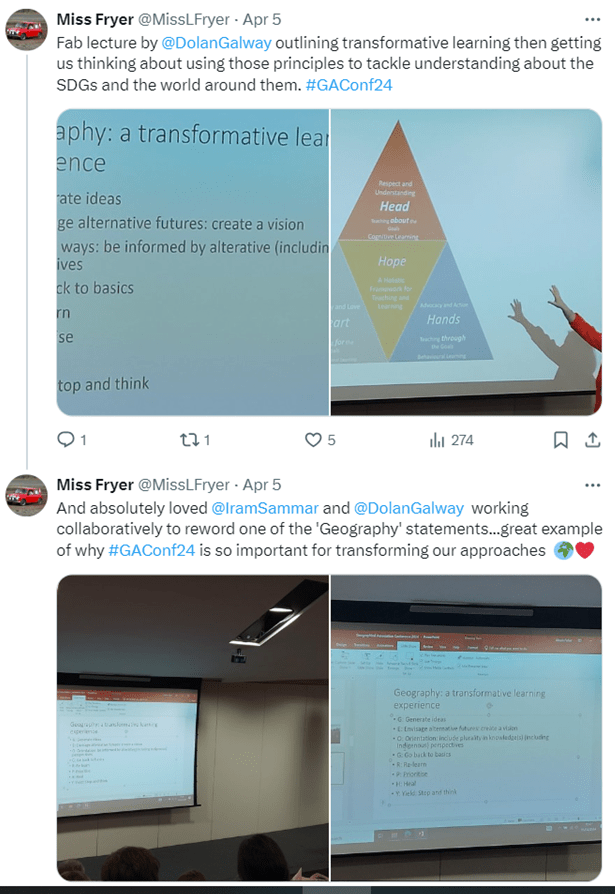
Decolonising is more than changing the curriculum and rethinking how we teach case studies near and far, it should be in our consciousness. @MissLFryer, in her post kindly documents what true Engaged Pedagogy, as advocated by bell hooks, looks like. During the question and answer session, Professor Dolan Galway accepted my critique of her initial ideas on Geography as a transformative learning space. I pointed out that ‘Other ways’ could be viewed as an Orientalist way of demonstrating transformative learning, so I suggested ‘orientation’ be used instead. Hope and Izzy encouraged me to speak out and ‘just say it’, so I was also able to help Professor Galway change the sentence so ‘Indigenous’ is capitalised and conceptually ‘plurality in knowledge(s)’ is added, informed by my engagement with Professor Tariq Jazeel’s writings on postcoloniality and decoloniality. We were impressed how Professor Galway jumped onto the computer and quickly amended her PowerPoint slide there and then. It was very emotional for onlookers to witness – a demonstration of the learner being taken seriously by the teacher/lecturer. I thought of Kit Marie Rackley, an individual who has been very active advocating for Indigenous Peoples’ knowledge(s)/rights within Decolonising Geography collective, so learning through their work has been invaluable – I have been able to manifest strength to speak up, even if you feel marginalised, or not ‘heard’ or ‘seen’.

Original text
Reworded version
X post by @MissLFryer

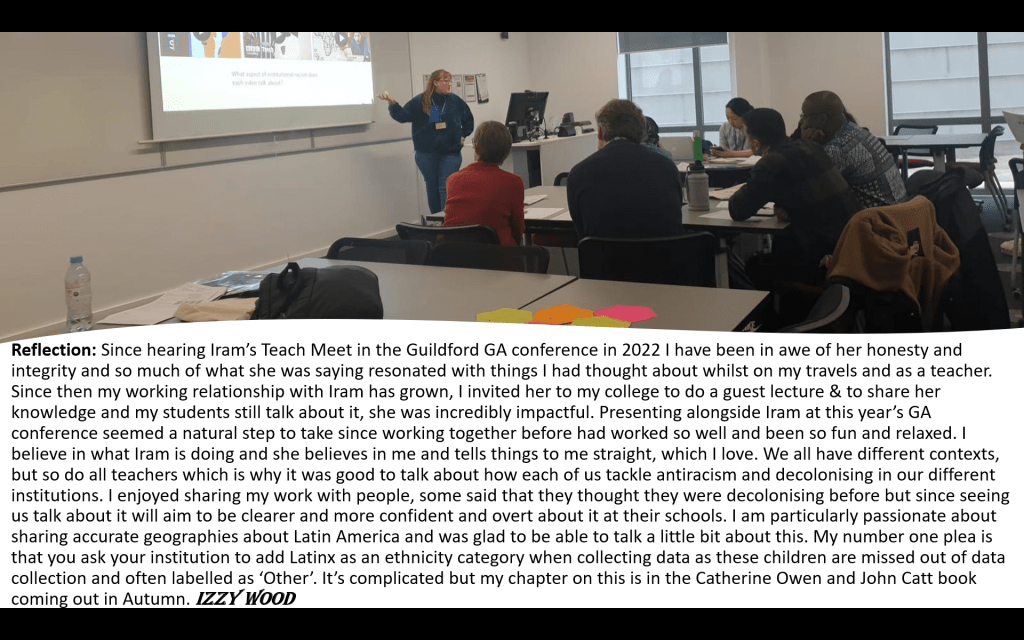
This brings us to the session planned by our team of talented decolonial teachers (engaged with the Decolonising Geography collective) for the GA Secondary Phase Committee (@ga_spc), where a fellow geographer said, ‘it stood out as a beaming example of progress and empowerment.’ Stephen Schwab, chair of the committee with his ongoing support and encouragement helped us title the session: How to begin the process of decolonising case studies for Key Stage 3 to Post 16 Geography Education. It was a horizontal effort led by a trio of passionate educators, myself and the dynamic duo of Hope and Izzy, so the session was packed with hands-on exploration of practical strategies, rich ideas, and invaluable resources for rethinking the narrative of geography education. We initially met up on a few occasions before we embarked on a journey to unravel the complexities of colonial legacies, fuelled by a commitment to reframing our own teaching methodologies and empowering our students to engage critically with the world in which they live and share.

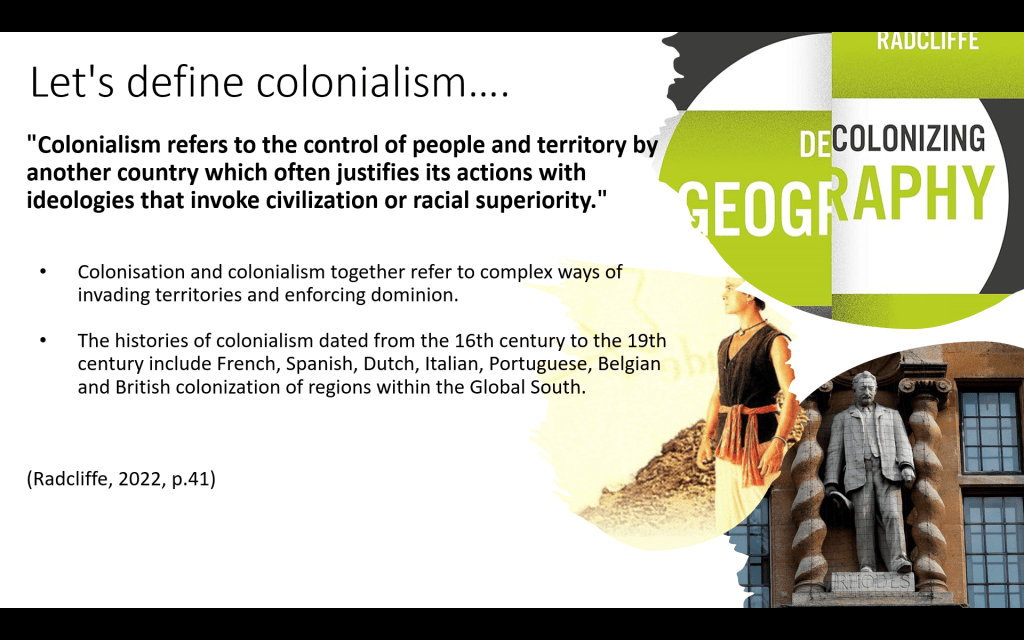
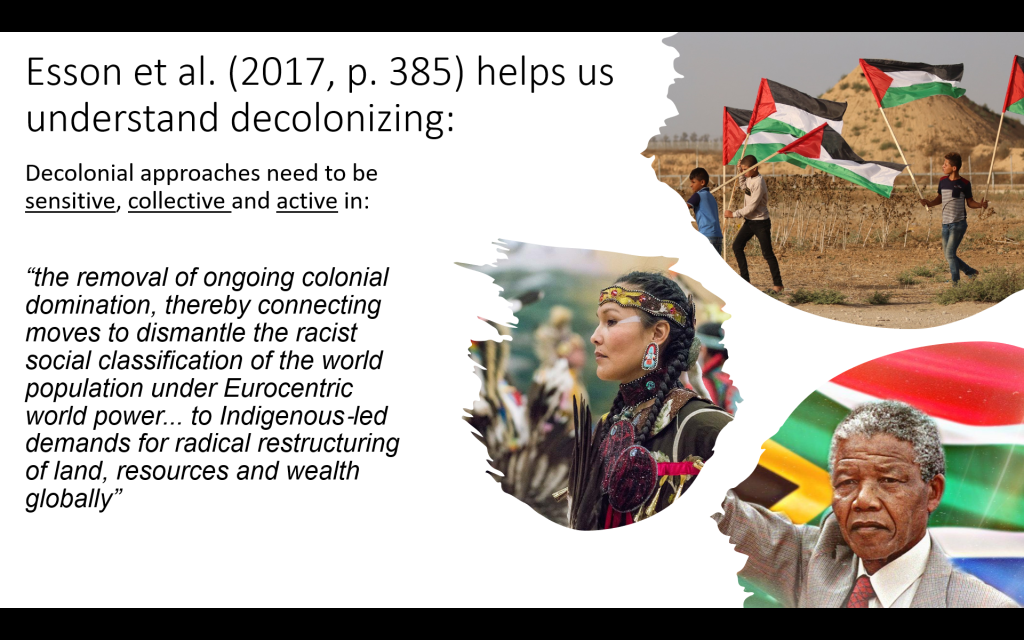
I began the session by demonstrating my passionate dedication to redefining the narrative surrounding colonialism and decolonising through personal geographies and heritage. My fifteen minutes initially delved into the profound insights of Professor James Esson for defining decolonising; and Professor Sarah Radcliffe, in defining colonialism. Both demonstrate academic brilliance as guiding lights illuminating our understanding of complex terms toward a more inclusive and equitable education system.

Slide from Iram Sammar’s presentation, GA Annual Conference 2024

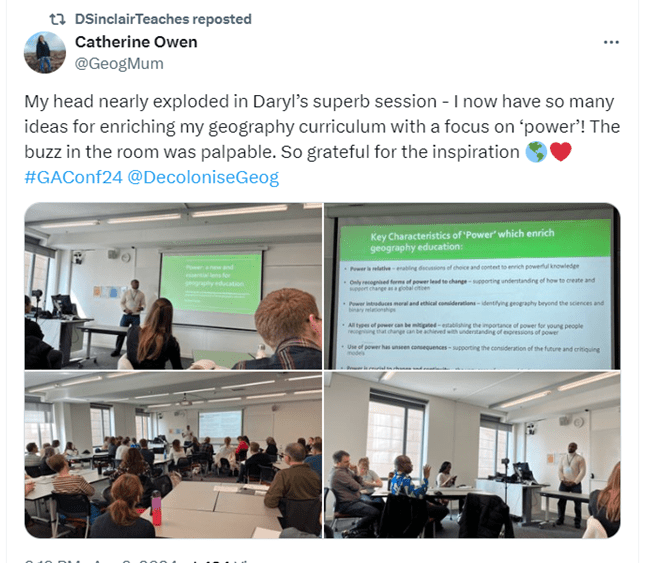
Our session’s exploration began with a deep dive into the concept of colonialism itself, deconstructing its significant and complex impacts on both past and present societies. Taking from personal geographies and scholarly discourse, we helped the audience navigate the complex terrain of colonial histories through definitions and case studies, acknowledging the blemishes they have left on the landscapes of education. We aimed to present a session that modelled the transformative power of decolonising case studies we already use in the classroom – often inherited, where choice is limited. The pivotal tools in shaping students’ understanding of the world was explored to help our audience recognise how traditional case studies often perpetuate colonial narratives and uphold dominant power structures. The concept of ‘power’ was further explored in Daryl Sinclair’s own amazing session later, the following day (see Catherine Owen’s post below). Thus, our mission within the Decolonisng Geography collective has always been clear: to decolonise our case studies and offer students a more nuanced and plural perspective informed by collaborating with decolonial thinkers.

Post on X by Catherine Owen

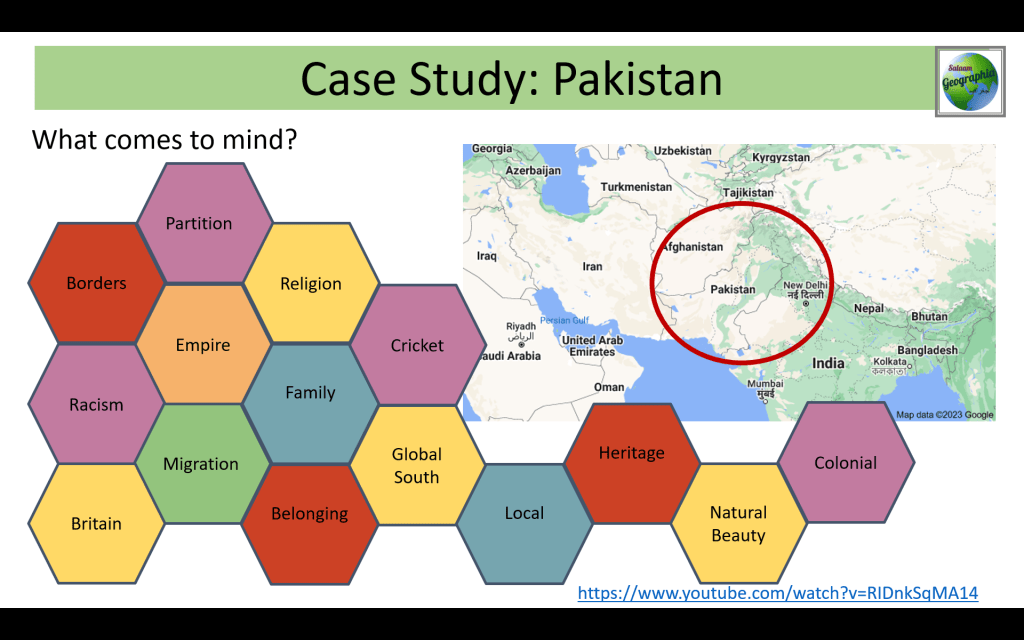
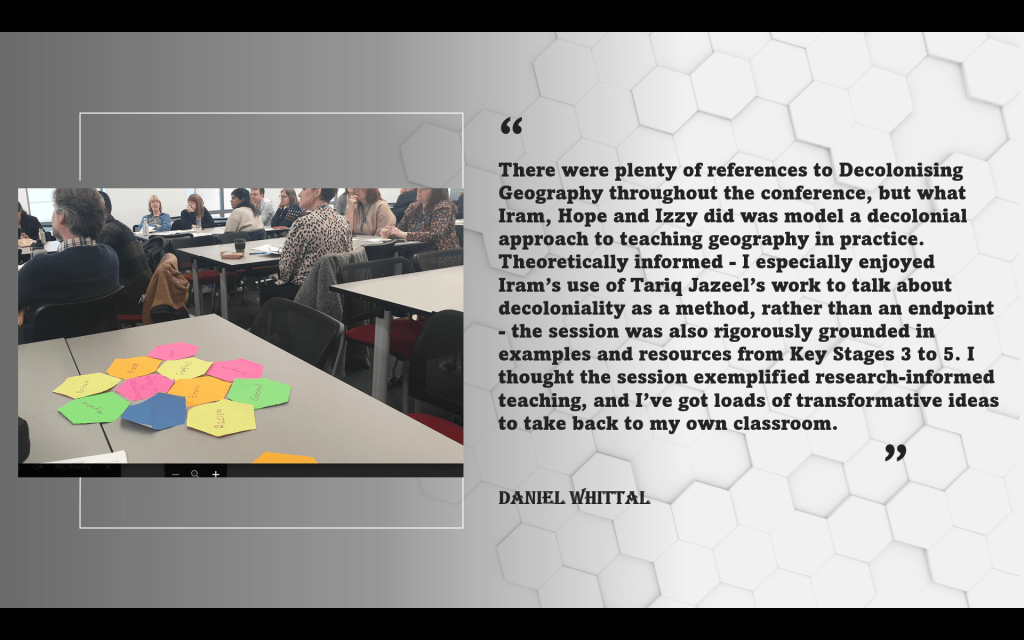
With our own session, we passionately embarked on this journey of decolonisation, using practical examples from our own classrooms as guiding strategies. I shared insights from the Pakistan case study, demonstrating how a hexagonal method can serve as a powerful framework for deconstructing colonial perspectives and embracing the richness of diverse cultural narratives. This way teachers can feed in important themes and narratives often left out in the textbooks and GCSE and A level specifications, within the UK context.

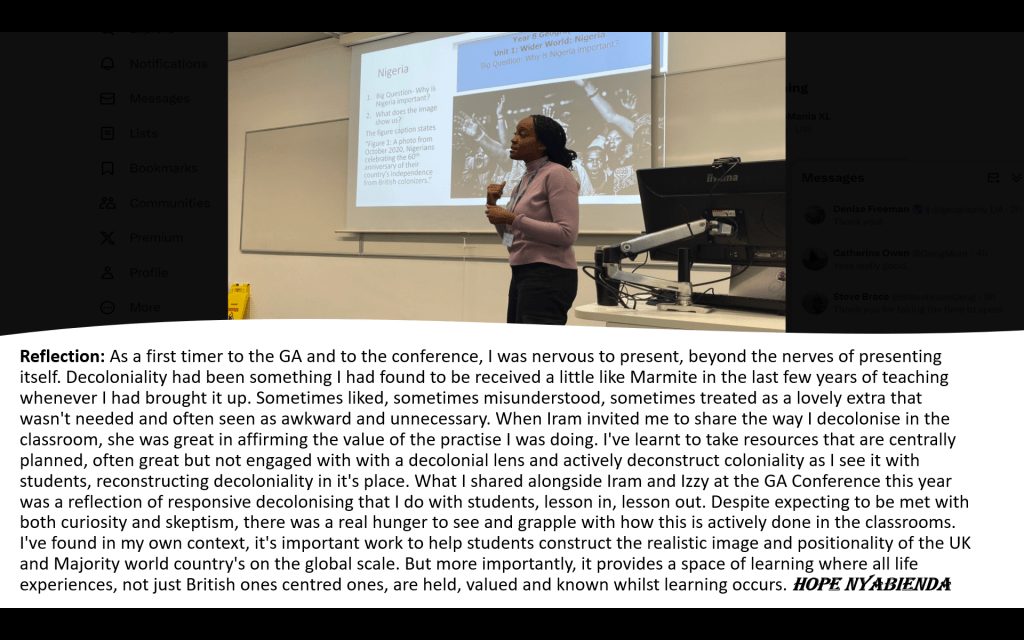
Hope, with her infectious enthusiasm and early career commitment, guided us through the process of decolonising the Nigerian case study inherited from a more traditional resource from years before. Through her lens of ‘pride’ and ‘identity’ she helped the audience experience the challenge of reimagining Nigeria not only as a product of colonial exploitation, but as a vibrant example of culture, resilience, and heritage. She asked the floor to critique the given resource sheet, so it could be seen how flawed older resources in departments can be. Together we grappled with how teachers might begin the process of decolonising through a discussion of why the resource was centered around a Eurocentric worldview. The atmosphere was electric and conversations lasted through lunch (although I was observing a fast).

Izzy brought her invaluable expertise to the session, offering practical strategies and real-world examples to empower educators in their journey towards decolonisation – with a particular focus on Colombia and the geographies of Latin America. Together, with her personal geographies, she wove a tapestry of inspiration and empowerment, equipping attendees with the tools and insights needed to embark on their own transformative journeys. Izzy demonstrated practical ways to decolonize the Colombian case study, aiming to shed light on the diverse richness of Colombia beyond stereotypical narratives around crime and poverty. With a keen focus on indigenous communities, Izzy’s approach shed light on the integral role diverse groups play in shaping Colombia’s cultural tapestry, where she talked about how ‘real interviews’ from her own qualitative methods were incorporated into her lessons – with migration stories from Venezuelans. By delving into the traditions, languages, and customs of indigenous peoples, Izzy talked about engaging learners with a deeper more nuanced understanding of Colombia’s intricate socio-cultural landscape. Through this decolonial perspective, Izzy demonstrated the resilience of Indigenous communities and shared insights of their ongoing contributions to Colombia’s identity and heritage, hence a more inclusive and comprehensive understanding among her learners.

Our session was more than just a series of fifteen-minute presentations, we viewed it as a collective call to action, a loud demand for change within the field of geography education. As we shared our experiences and insights, we were told we ‘energised the room’ and sparked a flame of hope and urgency to initiate a decolonial move towards a more inclusive and equitable educational classroom experience.

Quote from Daniel Whittal

The Geographical Association Annual Conference has indeed served as a crucible for the possibility of change, with the continuing of conversations and scaffolding of action towards a more just and decolonial future. As educators, we all have a responsibility to challenge the mainstream ‘whiteness’ and ‘colonial’ narratives within geography education, this includes disrupting the entrenched power structures and uplifting marginalised voices. By decolonising geography case studies, we are not only reshaping the curriculum – we are empowering students to create a new world for themselves, one of change, filled with plural knowledge(s), empathy, and critical thinking skills, so learners and teachers can imagine a better world.

The process of decolonisation may be long and tough, but with love, dedication, and collective action, we can help students and teachers imagine a future where every learner’s voice is heard, every culture is known and respected, and every narrative is valued. United and through collaboration, we can embark on this transformative journey together, manifesting an improved trajectory towards justice, coexistence, and equitable futures in our world, especially for the many generations to come.

Sharing Research in Geography Education

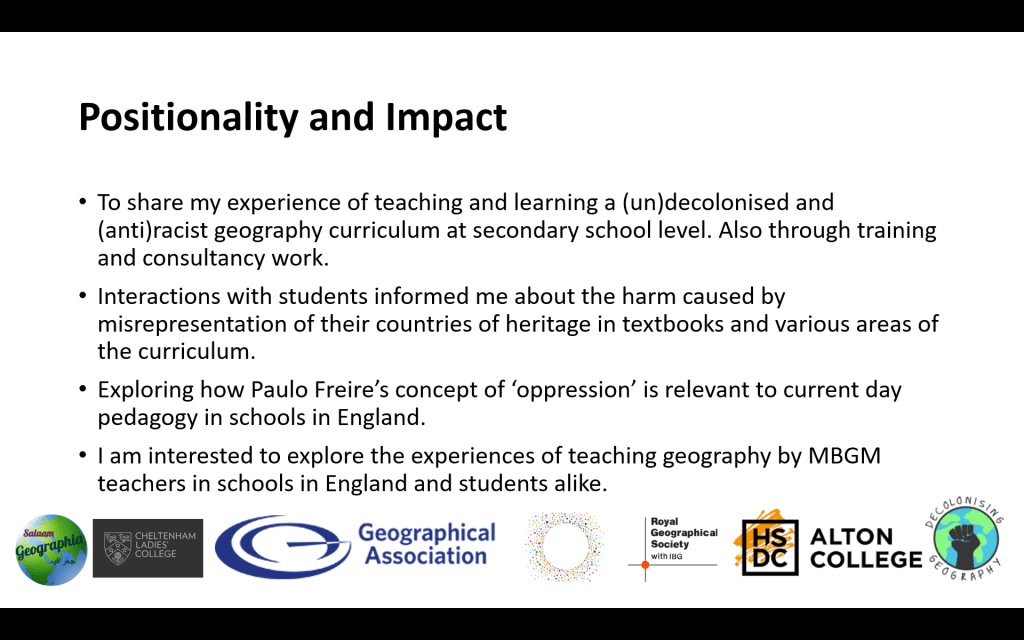
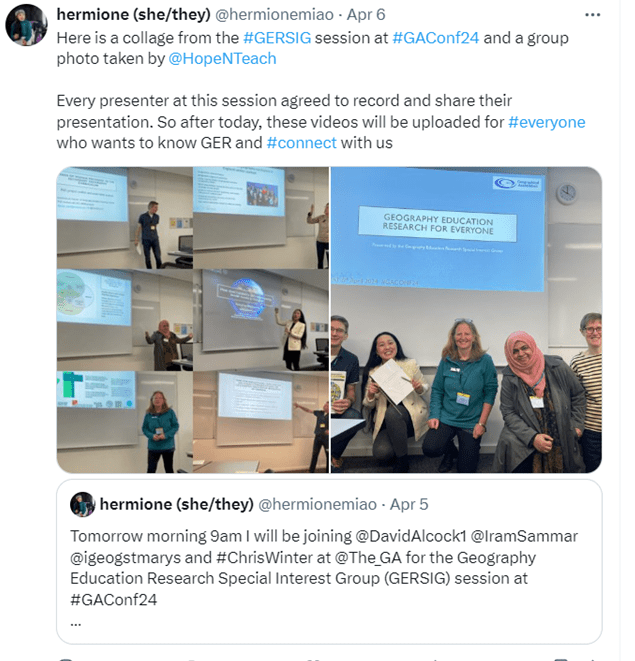
After some wonderful catch-ups with fellow Decolonising Geography members, I prepared for the Geography education research for everyone session with David Alcock and Dr Hermione – here I briefly shared my own doctoral research so far. It was very useful to explore the fascinating research in Geography Education, especially as it was directed towards impacting teachers, researchers and students who are interested in becoming engaged with research. We all had the opportunity to select aspects of our research and present a five-minute summary – which for me was never going to happen. Keeping to perfect timing when talking about research is so difficult, particularly for those who have so much to share. It really was a fabulous idea and the session sparked important discussions about funding, collaborations and moves towards a progressive and transformative geographical educational experience ‘for everyone.’ My focus was on rationale and impact.

Taken from Iram Sammar’s presentation at the GA Annual Conference 2024
X post from Hermione
X post from Matt Finn

My research starts with the simple, yet complex inquiry into Who am I? With this activity, we are able to make connections with the local, regional and more global realms of the world. Before I begin any discussion in the classroom about identity, race, or heritage, I do so by requesting people take a minute and think about the following questions:

  • Who are you?
  • Are you a part of the ‘coloniser’ heritage? or ‘colonised’ heritage? Or perhaps both? In light of what I have discussed so far.
  • What connections can you make between colonialism and the discipline of geography as we know it today? 

In terms of impact, I now offer CPDs for geography teachers and educators and talk about how this activity can open up dialogue with your students and have written an article for Teaching Geography (GA journal for teachers) and numerous blogs.

So let me talk you through my personal geographies!
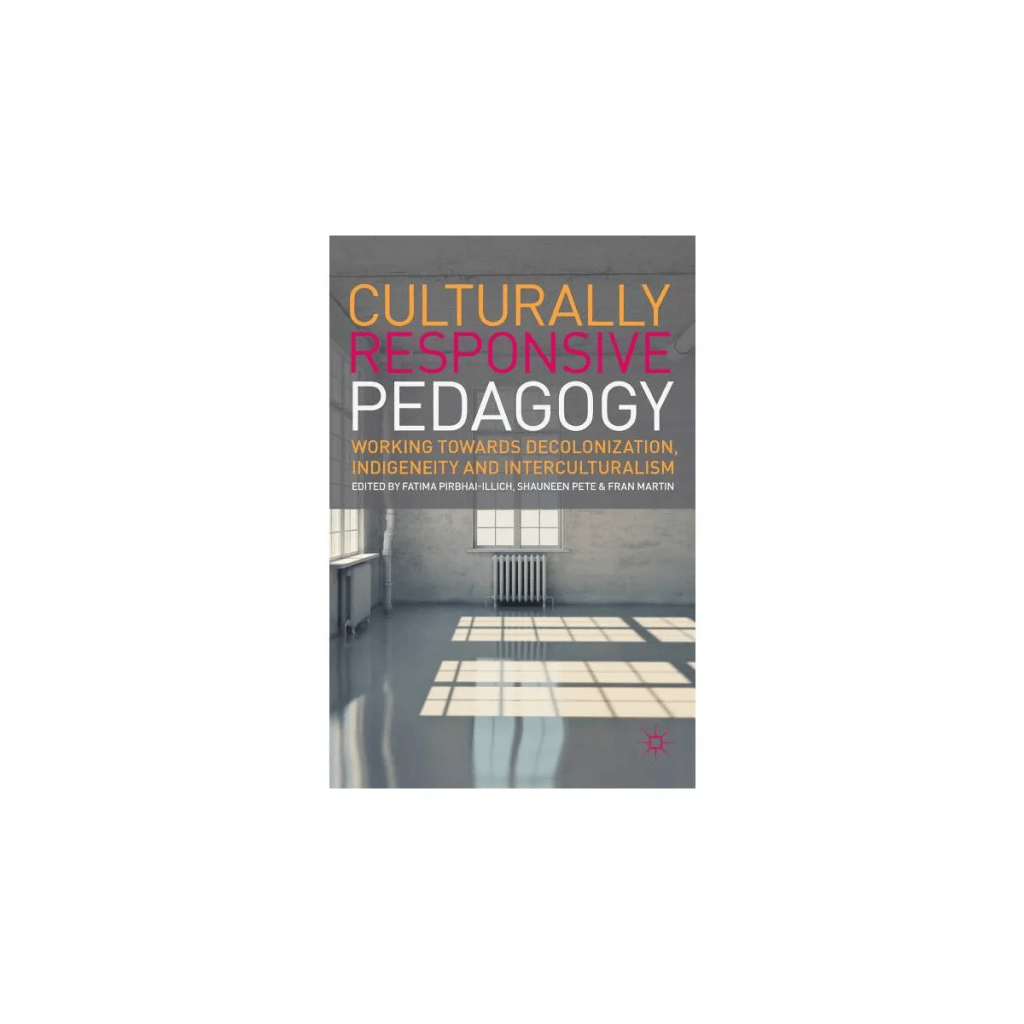
I would say, I have a heritage rooted in Pakistan which is in South Asia, hence a former colony of British Empire …as Pakistan was a part of India…before partition – where India was colonised by the British…Known as the British Indian Empire…but known in Arabic as the Al-Hind, or Indigenously known as Hindustan. So, I position myself within the lens of a former ‘colonised’ heritage. It is important to think about the importance of this question because my world view is probably a whole lot different to say someone with a heritage of the ‘coloniser.’ So if you are British white it places you in the ‘coloniser’ heritage category -not to suggest a person within this positionality is perpetuating such ideologies attached to it. This questioning comes from the text Culturally Responsive Pedagogy (see Fran Martin and Fatima Pirbhai-Illich et al, 2017), where Fran in her talks mentions that she is from a ‘coloniser’ heritage; and Fatima mentions she is from the ‘colonised’ heritage. Useful to understand how our thoughts can be so different. Where one might be healing and the other might need to show patience and be comfortable with the uncomfortable. So coming back to this idea of Who am I? you can see straight away, all the global and local geographical links you can share with your students.

Iram Sammar’s slide from her presentation at the GA Conference 2024

I start with an image from the Bollywood movie Lagaan. I use this image to demonstrate to my students what life must have been like for those colonised by the British Raj. I could talk in-depth about each character in the movie with this image but you may want to listen to my very first presentation for GEReCo. This indicates that we must approach texts like Prisoners of Geography (as mentioned by Dr Esson in his lecture) with caution, especially some of the statements that try and explain the geopolitical relationship between India and Pakistan in a very stereotypical and divisive way – as a Pakistani heritage geography teacher, I find the chapter on India and Pakistan very difficult to read. I feel it lacks the nuance of some of the realities faced by these countries and its peoples – and Britain’s role in causing those colonial harms and conflicts.

Just by looking at these images and movies, you can see the hybrid nature of my existence, because of my unique positionality as Muslim, Pakistani, Female Geography teacher teaching in England, UK. A bit of a mouthful, right? But something I bring to the geography classroom, not by choice – but because this is what the students see when I enter the room. Now I have embedded it within my research.

So, when you next meet your students have a go at decolonising, with you, they too will share their expertise about their own personal geographies – if you haven’t already, try this in your classes. Be sure to drop me an email on how it went. Remember, your students need to explore the geographies embedded within their own lives as they are the experts of themselves…hence their personal geographies.

I do hope you enjoyed reading through this reflection and that it has given you something to think about when engaging with decolonising geography and the process involved. I look forward to Hina Robinson’s presidential year with the GA, and I am very much excited about this conference taking place in Oxford ‘where I spent most of ma days…chillin’ out, maxin’ …relaxing…♫♫♫’ (guessed the song?). Hina has been an inspirational figure in Decolonising geography and her podcast with Professor Tariq Jazeel sparked an interest in me to pursue what decolonising is and what it could mean to students of geography within school and beyond – hence I am now ‘doin’… ma doctoral’ writing chapters with the ‘big boys’ like Professor Steve Puttick (if I may Steve!) at Oxford University.

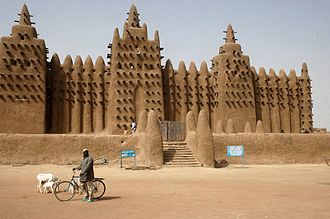
Thank you for reading and enjoy learning, unlearning and teaching through decolonial and antiracism praxis. Representation matters, as Aisha Thomas emphasises in her book. I leave you with an image below of الجامع الكبير في جينيه (or the Great Mosque of Djenné) in Mali. It means a lot to me as I spotted one of my PGCE tutors Dr Alun Morgan at the conference after Professor Esson’s transformative keynote lecture. I had the opportunity to reconnect and tell him how, his showing an image of this masjid meant the world to me during my own teacher training days, as I felt represented through my Islamic spiritual embodiment. We both felt the emotion because I had never had the chance to tell him, it was his ‘unconscious’ culturally responsive pedagogy through showing the group this image, that I felt I belonged in the geography community. This small pedagogical act informed how I taught thereafter and also inspired me to explore Islam and geography for my Masters and not shy away from who I am. Another blog on this is incumbent on me. I could mention many more amazing geographers (and sad I haven’t, but I value you), but until next time, Peace and Salaams.

السلام عليكم ورحمة الله وبركاته

Credit: Wikipedia

Fieldwork and Supporting Muslim Students

Image taken by Iram Sammar

“Miss I need water and a place to pray”

Written by Iram Sammar

Date: 11 Rabi’ II, 1445 AH (26 October 2023)

Whilst field trips provide valuable skills and opportunities for students to develop their senses and explore new environments, they may have never experienced, their emotional, spiritual and cultural needs are essential to consider. As students deepen their understanding of this complex world, we as educators can create inclusive spaces where all students, regardless of their cultural, spiritual or religious belonging, feel valued and supported. This piece will highlight the many ways we can ensure positive support for Muslim students on geography field trips.

Praying Salaah

The quote (above) is taken from a Year 11 student on a field trip to a coastal location, where several Muslim students asked me if they could pray during the lunch break. They placed their jackets on the sandy beach behind some vegetation and prayed the mid-day Zuhr prayer in Islam.

‘Allah hu Akbar’, which can be translated to mean ‘God is great’ is what the student leading the prayer recited. The group of students behind him followed his lead and they all began to pray together. What they were engaged in, is called ‘Ibadah’ in Arabic, or worship. When the prayer begins, you will find that the students may not respond to you if you call them or ask them a question. This is not out of disobedience. The beauty of Salah is remembering God, or Allah (ﷻ) and reciting verses from the Qur’an (Majed) which ask for guidance and goodness. For Muslims who choose to adhere to the teachings of Islam, Salaah (or prayer) is considered one of the five obligatory rights of an adolescent Muslim – so if you teach primary school-age students this could be as young as years 5 or 6. Some Muslim students take Salaah very seriously and desire to pray it on time and with full concentration and focus.

Your students may want to pray at certain times, especially during lunch after 13:00pm depending on the time of year. There are five daily prayers in Islam: Fajr, Zuhr, Asr, Maghrib and Isha, which take no longer than 5 to 10 minutes. This requires a wash facility, as students may want to perform ablution of the mouth, nose face, arms and feet – each washed thrice. Be mindful of these prayer times and provide a quiet and private space for the student to observe their religious rights. Boys and girls may want to pray privately to each other. Although, you may find a male student leading the prayer, where he may lightly recite the adhan, or call to prayer. Do speak to the students and their parents to help you in understanding these needs. As you educate yourself about what the students do daily at home and in the masjid (mosque) with regard to Ibadah (worship and prayer), you will feel more comfortable talking to wider school staff about these rights and needs.

The five daily prayers in Islam are a fundamental form of Ibadah, or worship and a valued part of a Muslim’s daily routine. It is good to familiarise yourself with the the five obligatory prayers:

  1. Fajr: The pre-dawn prayer, performed before sunrise.
  2. Dhuhr: The midday prayer, observed after the sun has passed its zenith.
  3. Asr: The afternoon prayer, offered in the late afternoon.
  4. Maghrib: In the evening, performed just after sunset.
  5. Isha: The night prayer, observed after the disappearance of the twilight.

The prayers do not take long to pray and consist of a specific number of units called Rak’ahs, which require recitations from the Quran and specific physical postures, including standing, bowing, and prostration. Access to water is important for ablution, however if there is no water available, students can perform Tayammum. This is a purification method in Islam and involves using clean earth or dust to perform dry ablution, which allows a person to purify themselves before prayer or other religious activities. Tayammum is a practical solution for Muslims when in freezing altitudes (or desert environments) where using water would be difficult. To perform tayammum, a person follows these steps:

  1. Intention: Have the intention to perform tayammum for purification.
  2. Strike the earth: Gently strike the hands on clean, dry earth or stone, ensuring the palms and fingers come into contact with the dust.
  3. Wipe the face: Wipe the face with dry earth-covered hands.
  4. Wipe the hands: Wipe the hands, including the wrists.

Tayammum is only performed in emergency situations, but it is good to know. Some of your students may not have heard of this, so sometimes this extra knowledge deepens the relationship and trust of your Muslim students.

Understanding Spiritual Needs

Before approaching students about their faith or spiritual matters, it is crucial to foster a meaningful and sensitive approach to communication. It is good to cultivate a deep and respectful engagement with Muslim students and their parents or carers to get to know their personal needs and religious obligations. This could include talking about dietary preferences, prayer facilities, and other worries especially for females with modesty concerns. Prompting such dialogue, we show our dedication to inclusivity and respecting their religious, spiritual and cultural needs.

When considering dietary preferences, it is important to be aware that many Muslims eat halal or kosher food (which is permissible in Islam for a practising Muslim to eat). Meats such as halal chicken, beef and lamb, which is generally within the herbivores category along with seafood such as fish. It is important to be mindful that pork is prohibited to eat for Muslims who follow Islamic dietary guidelines. If there are no halal food options available during the trip they can eat vegan and vegetarian, better still, allow the student to bring their own food.

Modesty

Modesty is important to consider, as some Muslim students may adhere to Islamic dress codes, such as wearing a hijab or modest clothing in the form of an abaya (long dress). Boys may want to cover their naval to the knee whilst engaging with activities such as swimming. Be sure to provide access to privacy, in place where they change clothes or shower – the key is to respect their adherence to dress modestly during physical activities.

Creating an inclusive environment is important, especially by educating the other students and assistants on the trip about fellow Muslim students and their cultural and religious rights and beliefs. Do place emphasis on the values of identity, respect and inclusion. Motivate and encourage full participation, while keeping in mind and respecting a Muslim student’s decision to opt out of certain activities that they might feel impinge on their religious rights.

Ramadan Kareem

You may have noticed that this piece has the Islamic date with the Gregorian date. Muslims observe the Islamic lunar calendar, which is also known as the Hijri calendar. This consists of 12 months, just like the Gregorian calendar. However, because it is based on the lunar cycle, the months in the Islamic calendar have different lengths compared to the months in the Gregorian calendar. Here are the 12 months in the Islamic lunar calendar:

  1. Muharram
  2. Safar
  3. Rabi’ al-Awwal (Rabi’ I)
  4. Rabi’ al-Thani (Rabi’ II)
  5. Jumada al-Awwal (Jumada I)
  6. Jumada al-Thani (Jumada II)
  7. Rajab
  8. Sha’ban
  9. Ramadan
  10. Shawwal
  11. Dhul-Qi’dah
  12. Dhul-Hijjah

All these months are useful to familiarise yourself with, as your students will observe various rights that differ from month to month. Islamic religious observances and determining the dates of Islamic holidays is useful, including Ramadan, Eid al-Fitr, and Hajj, among others. Since the Islamic calendar is lunar, it is about 10 to 12 days shorter than the Gregorian calendar, causing Islamic months to shift in relation to the Gregorian calendar each year.

During Ramadan, students may fast from dusk until dawn. Ramadan is the Islamic holy month of fasting and increased Ibadah, observed by Muslims globally, and it is important for students on field trips to feel supported. During this holy month, Muslims fasting will refrain from food, drink, and physical acts (such as sex). Fasting teaches self-discipline; the ability to give up bad habits; empathy for the less fortunate; and increased kindness and spiritual growth. If you have planned an overnight trip, it is considerate to talk to your students about how they would like to break their fast or observe Iftar (meal after fasting). It is also good to arrange a clean place for the students to pray Maghrib Salaah, the evening prayer, performed just after Iftar. If you anticipate being out and about before this time, be mindful that the students may need to take water (small bottle) to perform ablution and a snack to break the fast. Students tend to just keep things discrete, however, it will be appreciated if care is taken with the little things.

Being thoughtful and supportive towards Muslim students on a field trip is about encouraging an atmosphere where students feel included through care, understanding, and respect. By creating safe spaces for individual needs for children from different faiths, we can maintain an anti-racism ethos, where we can promote cultural and spiritual awareness and ensure that every student, regardless of their beliefs and values, feel included and valued within the whole field trip experience. It is critical to support the principles of equity, diversity and inclusion that are integral to fieldwork education. You can apply this to students from other cultural or faith backgrounds, such as Sikh, Hindu, Jewish and Christian students (and fellow teachers and support staff). Knowing who your students are is essential to improve their experience of going on a field trip with you. Trust me, they will remember you for it.

As always, thank you for reading this.

IRR50 Conference: New Circuits of Anti-racism

“We are over here because you were over there”

A. Sivanandan

Written by Iram Sammar

Date: 20 Rabi Al Awwal 1444 AH (Sunday 16th October 2022)

On Saturday 15th of October, a transformational event enriched the souls of those seeking to improve the way anti-racism is understood, exercised and foreseen through discussions of racism, imperialism and new lines of resistance. As a teacher of geography and doctoral student, I was keen to benefit from the event to develop a sense of what it means to move cautiously into the future to encompass praxis and research into anti-racism. I found the event was not only for academia, but essential for teachers/educators in earlier phases in the education system from primary, secondary and beyond. The whole event was electric with amazing speakers and volunteers, all who made the experience warm, comfortable and inclusive. The programme for the day clearly defined and shaped how anti-racism research and education can give hope to not only those entwined in British society, but to our global links and solidarity with the international community. Educators do need to ask the question: where does our knowledge production come from? Is it solely from academia and historically white colonial narratives? What does it mean to decolonise really? Does IRR have some of the answers?

In the introduction, Sophia Siddiqui highlighted that “anti-racism today is so incredibly important, and it must be defended”. The discussions and conversations were truly inspirational and will and should spark even more important conversations in the years to come. There were many thoughtful conversations with even more thoughtful questions, answers and comments that followed each of the sessions. Adjacent to the main lecture podium was a unique stall where many of Sivanandan’s books and classic IRR publications and impressive merchandise were available for purchase. It was indeed a nice way to celebrate the important work the IRR has been engaged with historically and more recently.

IRR50 and the revolutionary act

From the very first panel discussion, you develop an understanding of the historical events and struggles that led up to anti-racist thinking and mobilising “because we don’t know where we are going until we know where we have been” (John Narayan the chair of this panel). The deputy editor of Race and Class, and wife of Sivanandan, Jenny Bourne, and the ‘legendary’ chair and joint editor of Race and Class, Colin Prescod provided a very thought-provoking conversation on the transformation of the IRR and what it has entailed since. 

The IRR has seen radical changes over the past fifty years that take us beyond the ‘add-on’ narrative of what decolonising and anti-racism actually does and is, in the complex structures of society and its institutions. It can be said that the IRR itself is an example of a truly decolonised institution, however institutions in the UK have an extremely tough job to keep up with this model – who is the Sivanandan of your institution? Even the IRR began as a neo-liberal imperialist think-tank, as its structure was rooted in scientific research through links with multinational companies, failed government initiatives and various other influential bodies driven by power and capitalist ideology. Something extraordinary happened in 1972. The actual workers of the IRR mobilised and overthrew the damaging dichotomy it was founded on, only to become the biggest anti-racist think-tank organisation to date. It just shows, working together through collaborations and in solidarity brings communities together.

To reflect on the history of the IRR, the panel brings to light the struggles of the 1970s felt by the ethnic minority communities in Britain, through extensive research and educational praxis.  Some of these struggles still stand the test of time, thus Jenny points out the following important ideas:

  1. Racism does not stand still – it changes its contours and impact all the time.
  2. There is no anti-racist blueprint, no orthodoxy – it is organic.
  3. Racism does not impact equally – we have to look to the groups and areas where its impact is felt most and where other important factors, such as class, rightlessness, gender and other characteristics that are linked are represented.
  4. IRR, as an organisation aspires to speak from the most oppressed, not to the policy makers and most powerful.
  5. IRR, pledges to think in order to do – looking to change things.

Much of the above comes from Sivanandan himself, with a strong reference made to Liz Fekete, who has been carrying on the legacy by keeping the IRR abreast of the new and existing issues as and when they arise. Colin Prescod amplifies Jenny’s words and emphasises that the conference is not to “reminisce” Sivanandan, but rather to “recommit” in the hope that the audience follows through with what the original struggles of the institute aspired to achieve. The founding members of the new and reformed institute were clear in their premise that, it was an organisation for the workers, where working together and as a collective was paramount to its new look. It was to work for the new migrant settler Black communities in the 1970s. How did the IRR achieve this?

  1. Taking sides with the new migrant settler Black communities campaigns on various issues that they faced – including equal rights within work, housing and education.
  2. Supporting their right to challenge the status quo on their existence – empowering asylum-seekers and new and existing migrants.

This was not an easy task. Many of these communities faced injustices everyday of their lives. Their everyday geographies were embedded in horrific injustices that would often lead to imprisonment, homelessness and austerity. My own parents stumbled on such struggles, which I felt as a child growing up and still feel as an adult living in Britain today. Some of these personal experiences can be explored here. Colin addresses how racism often resulted in injustices for Black communities. Sivanandan (1990) talks about two types of racism “the racism that discriminates and the racism that kills.” Whenever people would ask him what the IRR is about he would respond by saying “we do not speak to but from”. His most iconic phrase remains “we are over here because you were over there” – one I have used many times in class before any discussion about ethnic minorities in Britain. It is a phrase that sometimes creates gasps of bewilderment, and other times smiles and laughter, particularly within a multi-ethnic/cultural classroom setting. Another one is “we all wear passports on our faces”. My own interactions with anti-racist pedagogy in teaching geography have been explored in the GEReCO forum with Dr James Esson and Dr Angela Last. I am born to a family who endured the kind of racism Sivanandan wrote about – unfortunately ‘very little has changed’, as Paul Gilroy stated in his inaugural presentation early in 2021.

Screen shot.from IRR https://www.youtube.com/watch?v=uTy5KZAx5vY&t=9008s

I jump to the keynote conversation between Barbara Ransby and Derecka Purnell, as it was also nothing short of breath-taking to say the least. They discuss the New Lines of Black Resistance in the US: undoing racial capitalism and the carceral state. This intergeneration and global conversation explores abolition and political growth in the US. The key ideas push towards coalitions and being unified – by recognising our differences through anti-racisms without homogenising the true essence of communities. Although this article should give an account of every speaker equally, I have highlighted only some key moments that were uplifting for the soul. In the discussion of Radical Internationalism and shifts in global order, the panel talked about the decline of western hegemony, war and imperialism, crises in capitalism, where the question asks what is the impact of these changes, and what does it mean to be radical internationalist today? The depth of arguments presented can only be justified by watching the full discussions here.

Finally , on the roundtable discussion of Antiracist Organising Today powered up the afternoon with key authors and anti-racist organisers below. The latest books on anti-racism, abolition, feminism and the role of the academy can be explored to help you improve your understanding of race and racism.

Thank you for reading, I do hope this reflection inspires you to engage further in anti-racist praxis and thinking – as you decolonise your curriculums, institutions and minds.

Hibah Food Parcels Update: Balochistan Flash Floods

Image: Salaam Geographia

Date: Muharram 10, 1444 AH (August 8, 2022)

Written by Iram Sammar

There is no other way to begin this blog, but to say thank you to all who have kindly contributed to the appeal for Balochistan.

Above, is a young man who crossed this body of flood water to collect his food parcel for his family. It was a difficult trek, however he told our volunteers that there are many on the other side who need help too. Our team of dedicated volunteers were humbled to see how much this small effort was needed and appreciated. Brother Ramzan told us that he sobbed when he saw young children patiently waiting for help to arrive, some playing and running around, others sitting with families on recovered charpais (beds/seats made traditionally). He explained how thankful and calm they were when the food arrived, even though some had not eaten a proper meal in days. He told us how they had lost their homes and belongings, where relocation was seen as a blessing. Together they prayed for all who sent their contributions – our thoughts and prayers are with them too.

The distinctive drainage basin of the Balochistan plateau is such that the following rivers form the nearby areas heavily impact flooding in the nearby villages. These rivers have confluences that join the Indus from west, which form the tributaries to the west – including the River Zhob and Gomal. The mouth of these rivers find their destination into the Arabian sea (River Hab, Porali, Hingol and Dasht). Some rivers such as River Mula, Bolan and Chakar drain into the Kachhi Sibi Plain. Below is the area our volunteers were able to distribute the food parcels to. The journey began at Jhal Magsi, after a three hour road trip from their own place of abode, Sohbatpur.

Google Maps: River Indus, Pakistan
Google Maps: Jhal Magsi in Balochistan, Pakistan
Image: Salaam Geographia

Each food parcel (see above) consists of items that a family would need to keep them nourished for at least a week – we tried to give more to larger families. A large truck was loaded with 90 food parcels and 54 large dhegs (pots) of rice. Each donation has been essential to this humble relief project. Below is an image of the food being cooked, as can be seen the wood fuel used to burn the stoves are all local and a short distance from the areas most affected from the floods.

Image: Salaam Geographia

Below is a young boy who cleverly made a raft with a converted charpai (hand-woven seat/bed) and two water drums. It is amazing how these youngsters have thought of innovative ways to help their families in times of difficulty. It was evident that the children were playful and full of life and hope, saying “Alhamduillah” (thanking God) for the help when it came. Many who lived on the opposite side of the river swam or sailed across to access the food parcels.

Image: Salaam Geographia

We were told that many families were living in open areas away from their original homes. There was a strong community presence where local women and men have come together to help each other take care of their children and the elderly. It was wonderful how our group of volunteers decided on the ground to distribute cooked food alongside the food parcels, especially as there is limited access to cooking facilities. Below are individually packed rice for people who had not eaten for days. Those who distributed the food are real heroes, as they quickly identified the state of emergency particularly with the number of vulnerable members of the communities, such as children and those who had a disability.

Image: Salaam Geographia

Unfortunately we were not able to raise as much as we had hoped, however with generous family and friends’ donations we are continuously sending funds to keep the food distribution going. If you are able to, this is an ongoing project so please do donate here.

Image: Salaam Geographia

Again, our volunteers thought to distribute sweets to the children, as they deserve the luxury of childhood – the joy of unwrapping a small sweet brought tears to one of our volunteers eyes, he said, “to see the children react to seeing the sweets was the highlight of our long journey to get to them. The roads were blocked and our journey was harsh, but worth it.” Living in so-called advanced/developed nations such as the UK detaches us from our natural instinct to exercise gratitude. When we think of our own children, we often want the latest gadgets and fresh food on the table (on time), however, true humanity is to want for other children what one would want for their own. Below are other items such as juices and water bottles, due to the intense heat these were kept cool with ice.

Image: Salaam Geographia

The aim of this blog has been to show you how small efforts can mean so much to people who need care and love right now. If we look at this world and its inhabitants as important and worth being there for, then we can grow and connect with each other – locally and globally. Salaam Geographia was set up to not only to explore geography as a subject, but to live it through bringing people and communities together, so we can get to know each other. Thank you.

 ٱلْحَمْدُ لِلَّٰهِ

Hibah Food Parcels: Balochistan Flash Flood Emergency

Image

Date: Dhul Hijjah 30, 1443 AH (July 29, 2022)

Peace and Greetings,

My name is Iram Sammar, I am raising funds for our brothers and sisters in Balochistan (see map below), Pakistan who are in need of your help, as they have been seriously impacted by flash floods in the area. Please donate here.

I am a geography teacher and PhD student based in the UK with a strong interest in learning and teaching about global issues. There have been a series of monsoon rains absolutely devastating the province with flash floods. People have seen the demolition of houses, roads and bridges, this includes a major link from Balochistan with Sindh. The impact this has had on the people and their communities is heart-breaking.

The areas that have already experienced the floods have taken away the Quetta-Karachi highway. Unfortunately this means that no traffic can move between the two cities. For this reason very little help is available.

Map of Balochistan, Pakistan

With the help of family and friends in Pakistan, I have been able to send funds for food parcels – however, we are now made aware that there are many more families that need basic food and assistance to cope with their situation. As you can see from the images, our selection of emergency food supplies are kept basic so more people have access to this.

Each food parcel cost Rs. 3000 which equates to £10/per package – as can be seen, we include: flour, rice, sugar, cooking oil, and various items the locals need.

For now, our main concern is to get food to those in need – 100 % of the donations are going to the people of Balochistan. Mohammad Ramazan (below) is currently the principle distributer (in charge of a team of volunteers) of our contributions and local to the area we have direct access to.

I started the Hibah Food Parcels project during the COVID-19 pandemic a couple of years ago and have restarted the campaign to now help the people of Balochistan. We were able to help over 400 families and continue to help. In Balochistan, we have already helped 60 families, however with your help we can increase this depending on how much we raise. Please note, these are not disasters caused by natural hazards, as people do not have the means to protect themselves or evacuate in time. This is a global issue where our actions in the mass consumer regions of the global North have led to climate change, where the global South countries feel the direct impact of our collective global actions.

Please help generously – you can do something to help, please donate here.

Thank you,

Iram Sammar