Geographies of Islamic Prayers

Get to know a bit more about your Muslim students. Prayer is important to Muslims around the world and it begins with Fajr in the morning before sunrise.

Written by Iram Sammar

Date: Dhul Hijjah 4, 1443 AH (July 4, 2022)
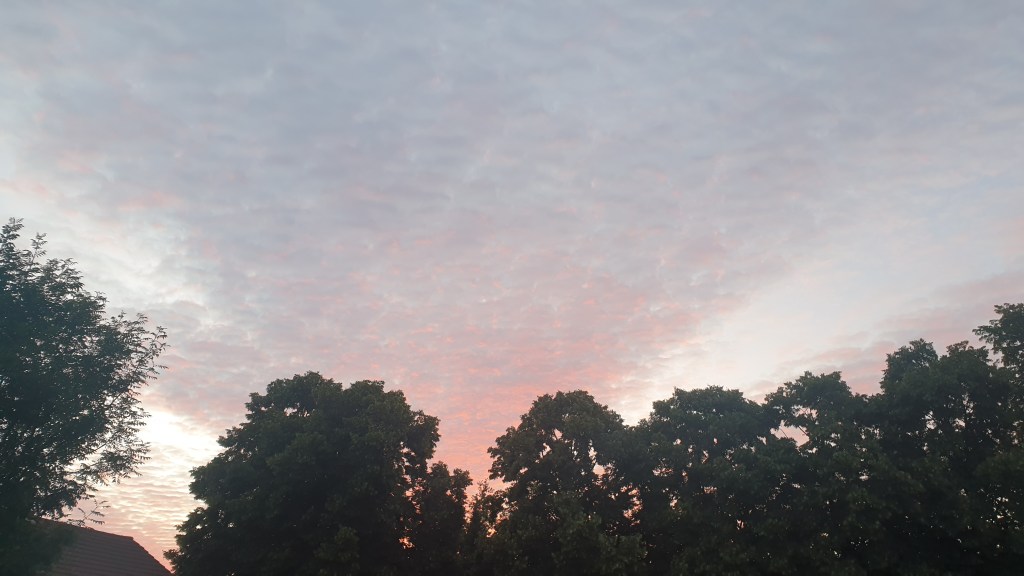
Image by Iram Sammar via Salaam Geographia

Fajr prayer

Have you ever encountered people in school or out and about, place a mat or cloth on the floor and recite ‘Allahu Akbar’ (God is Great)? If you teach students who identify as a Muslim, they will know what Salah is and what it means to a devout Muslim. Perhaps next time, you can ask them to tell you a little bit more about the Islamic prayer – only if they are comfortable to talk to you. Alternatively, keep reading and perhaps you can share your knowledge about Salah. Some may call this prayer or Namaaz, which is Persian for Salah, other languages have their own names. So, what are the geographies connected to this act of worship?

Fajr is the very first prayer of the day and it sets the tone for the rest of they day. Most of your students who choose to pray, will do so before school begins. Those who offer Fajr early in the morning, will be familiar with the condition of the atmosphere at this time, as it is a time referred to as day break (see photo above, it was taken at the time of Fajr). For this reason knowing when sunrise will occur is essential.

https://www.timeanddate.com/sun/uk/london

Morning time is a very peaceful time, other than birds chirping, it is very rare to hear the urban sounds of intense traffic or lively conversations on the streets. I often spend this time in the garden or going for a short walk around the block. It is overwhelmingly quiet and there is a sense of being, where it almost feels like time has stopped for you to enjoy. If you have not experienced this transitionary time, I urge you to – it will open your senses and give you a sense of freedom. As the urban sounds start flooding in, so does your busy life.

Yusuf Islam released a single which I recall singing as a child in the different Christian schools I attended as a child:

Morning has broken like the first morning
Blackbird has spoken like the first bird
Praise for the singing, praise for the morning
Praise for them springing fresh from the world

Sweet the rains new fall, sunlit from Heaven
Like the first dewfall on the first grass
Praise for the sweetness of the wet garden
Sprung in completeness where His feet pass

Mine is the sunlight, mine is the morning
Born of the one light, Eden saw play
Praise with elation, praise every morning
God’s recreation of the new day

Morning has broken like the first morning
Blackbird has spoken like the first bird
Praise for the singing, praise for the morning
Praise for them springing fresh from the world

The original piece was written by Eleanor Farjeon who was known for writing English children’s stories and plays, poetry, amongst other things. This hymn was the only one that did not conflict with my own Islamic beliefs at school. I didn’t like singing, but my teachers were adamant that children should sing. In Islam, Muslims believe that nothing or no one is associated in partnership with the oneness of Allah (ﷻ), or God in English. I often wished for teachers to just let me have my own beliefs as they prided over theirs. Growing up, it was very difficult explaining this to teachers and friends who were not Muslim. Often I would just keep my beliefs in my heart and only speak about Islam at home, as home was a safe space for me to explore and indulge in my faith and develop my spirituality. The beauty of faith is that it comes from the heart – no one can enter the heart as it is yours. When you sleep at night, the moment you close your eyes, no one but you, yourself can know what is in your heart. Faithful Muslims do believe this is the time to remember Allah (ﷻ), as the following verse of the Qur’an reveals:

‏قُلْ إِن تُخْفُوا۟ مَا فِى صُدُورِكُمْ أَوْ تُبْدُوهُ يَعْلَمْهُ ٱللَّهُ ۗ وَيَعْلَمُ مَا فِى ٱلسَّمَوَتِ وَمَا فِى ٱلْأَرْضِ ۗ وَٱللَّهُ عَلَىٰ كُلِّ شَىْءٍۢ قَدِيرٌۭ

Transliteration: qul in tukh’fū mā fī ṣudūrikum aw tub’dūhu yaʿlamhu l-lahu wayaʿlamu mā fī l-samāwāti wamā fī l-arḍi wal-lahu ʿalā kulli shayin qadīru

Translation: Say, “Whether you conceal what (is) in your breasts or you disclose it – knows, it is Allah. And He knows what (is) in the heavens and what (is) in the earth. And Allah (is) on every thing All-Powerful.” (Qur’an, Ayah al-Imran 3: 29, translation by Muhammad Asad)

https://www.islamawakened.com/quran/3/29/

As you would have noticed, the Qur’an is recited in Arabic and has its origins in the Arabian Peninsula.

Where is the Arabian Peninsula?

https://en.wikipedia.org/wiki/Arabian_Peninsula

Take a look at the image below. Write down three observations or ask three questions, or ask your students to.

https://en.wikipedia.org/wiki/Arabian_Peninsula

Here are my questions:

  1. Why is there a brown/beige colour?
  2. Why are the edges a darker shade?
  3. What are those white areas?

Start by asking yourself the most simplest questions, as these are the easiest to build on. One of the easiest ways to understand the topography of a place is to study a satellite image of it. Satellite images like the one above are captured through remote sensing – these are images taken by sensors on spacecrafts. An example would be Landsat, where land is detected and measured using the radiation from the earth’s surface. Some serious interpretation and analysis makes it possible to determine important information about all the oceans, landcover and atmosphere. With an actual topographic map, it is easy to identify physical and political aspects of a location – where you can identify boundaries determined politically.

Why is Saudi Arabia important to Muslims around the world? Earlier on, we were introduced to one of the five daily prayers, Fajr – so, which direction do people offer their prayers in? The direction of this spiritual act of worship links Muslims to the Ka’ba (see image below). The Ka’ba is a cube – shaped construction, ancient in time situated in the magnificent city of Makkah.
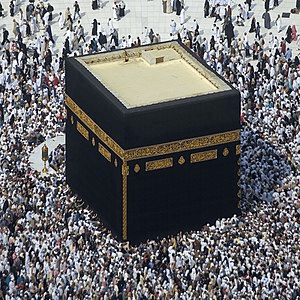
https://en.wikipedia.org/wiki/Kaaba

In 2012, I observed my own Hajj pilgrimage and was able to visit Makka and Medina, both are located in Saudi Arabia. In agreement with El-Hajj Malik El-Shabbazz (Malcolm X) as he wrote in his monumental letter, it was an eye opening experience for me. I had the privilege to see the global majority together in one city – for the first time, I was not the ‘other’, we were all from different countries and races/ethnicities. Whiteness as the ruling force faded into mythology – all races were united as one during the day of Arafat, as people in the evening, all one million of us lay under the stars in Muzdalifa, awaiting for the Fajr Salah – of course sleep takes over first. It was quite an overwhelming feeling. Islamic historical records (1400 years ago) indicate that Allah (ﷻ) directed Prophet Muhammad (ﷺ), during the second year of the Hijrah (the great Hijrat, or migration of Prophet Muhammad ﷺ from Makkah to Madinah), to redirect all prayers from Jerusalem, now to Makkah – this instruction is evident in the Islamic Holy Qur’an (chapter 1, verse 150). So, since this redirection, all Muslims face the Ka’ba when offering Salah.

In order to calculate the direction from one location to another, scholars have determined two main factors:

  1. The location of each point must be known, this is taken to mean the latitude and longitude.
  2. The type of path between the two points must be established; this is normally a choice between a great circle (or geodesic) and a rhumb line.

The direction of the Salah is called the Qibla. The Mercator map and its calculations within the flat projections are quite problematic when determining the Qibla, as the world looks very different on a flat map we see in an Atlas, therefore it is calculated with a compass so there is a more accurate ellipsoid.  Geographical technology has provided Muslims with accurate tools to establish the precise location of the Qibla. You can now just find the direction on your iphone through google, such as the Qibla Finder. If you are anyone like me, the traditional compass is just as accurate.

It is important to get to know each other so we can eradicate racist comments, feelings and prejudices. Islamophobia is a form of racism. Arun Kundnani in his book The Muslims are Coming describes it as a term which has been used more recently in the modern world, more specifically a product of the modern world, the scientific world, the world of capitalism – therefore a fairly recent phenomena. It has emerged from the 1970s onwards. Strongly, its emergence was after the Cold War in the early 1990s. Therefore, it is important for teachers and educators to explore reading lists that helps them decolonise and become anti-racist in the classroom. When a child from any racial or religious background/heritage is made to feel isolated, as I have in the past, it becomes a safe guarding issue.

I wrote this piece to raise awareness of how delicate relationships are and to show you how a little effort in educating yourself about a different culture or religious belief can help build a powerful resistance against racism or prejudice.

Geographical Imaginations and Reminiscing Roti

Image taken by Iram Sammar

More to a roti than you think, it is symbolic to all who see the struggle behind it; the cultural and spiritual connections; and the senses that are used to devour it.

Written by Iram Sammar

Date: Shawaal 26, 1443 AH (27 May 2022)

Roti, a perfect circle if you cook it daily, is eaten by many people around the world and is traditionally cooked daily in many South Asian, or Pakistani British households​. It has been the main bread cooked in my home since childhood and reminds me of my mother and heritage – she taught me how to cook it​, now I cook it for my children. Chapatti is another name for it, the classic flat bread, which makes me love being, well me. I have now mastered the perfect circle (see main picture). For me, roti symbolises more than food for the stomach. In Ealing, London there is a Caribbean shop named in honour of this delightful food, the Roti Kitchen – one reviewer writes: “Fantastic Caribbean food for fair prices and friendly staff members.” As you can see, the roti is not just a South Asian geographical imagination, the roti has geographical connections fit for a full geography lesson.

It takes me back to a childhood where a young woman, my mother, and her four children struggled to make ends meet in the 1980s and 1990s, in a country I call home – the United Kingdom. A home away from a home in Pakistan. A memory that is like a rose embedded in a thorny bush, where my search for belonging began. You may be wondering what has roti got to do with geography? How have I talked about the roti to engage my geography students and their geographical imaginations in the classroom? Well, sometimes the simplest concepts, memories and stories become the best learning your students will ever experience.

I was six when I first peered over the kitchen counter to have a go at rolling the dough ball into what then looked like the map of Pakistan.​ “Beta (child), like this”, my mother would say with a soft loving smile and warm glow on her face. “You take your time. Don’t force it into shape let it slowly take form…ahistah, ahistah (slowly, slowy in Urdu).” My mother made the roti with such diligence and care, almost like an elegant ballerina moving rhythmically with the flow of the moment. I could watch her all day. The feeling is with me today, so much so that whenever I come to make the roti, it becomes a performance that takes me into a different world, where concentration and love takes over. Now, my children watch me, especially my son. He has the same relationship I had with my mother. Now he watches me, as I make the roti and breaks the flow by demanding a position at the kitchen counter asking for a rolling pin. Soon he is accompanied by his two sisters who like to get their hands on the dough too. Yes, it becomes more of a play dough session, as you would get in any primary school classroom.

“Mummy, look, I made a map of Pakistan” said my son once. “Can I ask you something? Do English people eat roti Mummy…er… White people?” He whispered the word ‘White’ and looked around, as if there were people around us listening in.

“Er…some probably do” I responded with a puzzled look on my face. What a strange question, I thought! I actually didn’t know the answer.

“What I mean is…do they eat roti like we do, with saalun (curry)?” He clarified, looking at me wanting to really know the answer. ” Do they eat Chicken Tikka? Do they eat…er pilau? Do they eat Naan? Do they eat Pakora or Samosas…I mean in the house…not in the restaurants?” There was no food he missed out on your everyday Indian, Pakistani, or Bangladeshi restaurant menu.

“Woah, woah…of course they probably do. I know a teacher I worked with, he made daal (lentils) and used to get pitta bread from the local groceries.” My amazement at this child’s inquisitive nature got me thinking about the roti and how our conversation began to unfold into a geography lesson.

He didn’t stop. “Mummy was the teacher an English man…he wasn’t Pakistani like us? Was the shop Pakistani? You know, where he got his pitta bread from. Pitta bread is not roti.” This was the first time my son referred to himself as a Pakistani. “Tell me mummy, who taught him how to make daal?” By now he was well into the conversation with a soft frown on his face wanting answers to all his tiny, yet large geographical questions. “I bet he has Pakistani friends.” He was right, well kind of, the teacher I knew enjoyed expressing his appreciation for the flavours of what he called ‘Indian food’, impressed by the diversity that it comes with. For example he talked about how he spent a lot of time with Northern Indian families, where they ate roti, yoghurt and spices such as cumin seeds, whereas his Southern Indian families enjoyed curry leaves, coconut milk and mustard seeds with many fish dishes. However, the daal, is the one dish that he loved eating with roti the most – or pitta bread, because making roti was tricky according to him.

“Why do you think that his friends were Pakistani?” I asked, interested to discover where our conversation will take us.

“Because, daal is from Pakistan.” He said in a smug, matter of fact way. “It doesn’t grow here, like chocolate and and other stuff like tea. Mummy remember that story with that man on the bus? You told him! Remember you taught him geography on your way home…I still think that was mean. I want to learn geography too – so I can tell mean people not to be horrible to people with different skins. So, what’s the geography of daal? The orange daal that turns yellow when you cook it. Is it only grown in Pakistan?”

“Well, it could be India and Bangladesh too – we should do some research when we finish cooking and eating. Remember India and Pakistan were once one country. It is grown in countries where it is the staple food – eaten for nutritional reasons. You are learning about proteins in science – well it is a rich source of protein. Some people eat it in substitute of meat. In fact British famers have now started to grow different types of lentils over here too. It’s really easy to grow.”

“Really?” He looked at me and jumped off the stool and sat down to listen to me. “You mean vegetarians? My friend says he is vegetarian, he is Indian. Are Indians all Hindu…are there any Muslims there…or other religions…er like here in West Ealing? You know, my mate…you know from India, he says he doesn’t eat roti or Pakistani food. We talk a lot and we sing a song in school called roti in the pan…it makes us laugh. Teachers think we eat roti and saalun … and that’s all we do. It’s like a nursery rhyme.” I thought to myself: at least he gets to explore a different culture, I remember being forced to sing hymns in school. My teacher’s strong coffee breath still haunts me today. She used to come up really close and shout at children, mainly Muslims, who didn’t sing “we are climbing Jesus ladder ladder”. I even remember a fellow Pakistani student say “Allah” (Arabic for God) instead of “Jesus” – the teacher didn’t notice that, especially as this student was a great vocalist. It was strange how I wanted to say so much to my son, but I held back, knowing that he is young. Perhaps he is not ready for these conversations? Well, not yet anyway. Or perhaps he was mature enough to hear me out? He was seven.

My own story began in Lancashire, in a small town called Oldham where I attended a primary school with multi-ethnic children. Born and raised in Britain, you would think I fitted in, right? Bangladeshi children to my left and Pakistani children to my right.  I recall sitting cross-legged on my best behaviour, raising my hand to answer a question.  A little White English girl sitting behind me once noticed something different about me. She tapped my shoulder frantically.

“You’re so brown, look at your hand”, she said, “I get like that when I go on holiday. Miss why are people in this class brown and so…er dirty? The girls are so funny, they wear trousers underneath their dresses. You all eat chappatis…not proper food like us…you should try toast. Miss is that why they don’t look clean like us? Do you eat food like us or do you just eat curry and chappatis?”

“Come on class, give each other a chance to speak. Yes Iram” said Ms Hud (pseudonym) completely ignoring the young girl’s question. I just froze and did not know what to say. It was the first time I experienced being singled out for the colour of my skin. I don’t know why but I felt awful and teary. As a four year old, you don’t really know how to channel your emotions that are so deeply rooted in race and racism. When you think of a four year old, you think comical chatter, questioning, cheeky behaviour and generally happiness. Well isn’t that what a four year old should experience? The rebel in me turned around to look at the girl in the eye. She was smiling back at me, with no malice in her heart.  This confused me so much that I felt awful for thinking bad of her. I was the other. In response to Gayatri C. Spivak’s question, Can the Subaltern Speak?, I would say not on this occasion. Here the White teacher and student had full control of the narrative – the only thing I could do is stare into their eyes questioning them ‘othering’ me. They really did not consider me an equal. Although, I did feel equal to them. Actually, they both seemed ridiculous and uneducated to me, and I was only four. I never once felt their behaviour towards me or the other students was justified. Imagine how my Indian/Pakistani/Bangladeshi ancestors felt during the British Raj? The poor farmers fighting the imperialist colonisers for their indigenous land. A clip from Lagaan comes to mind. I often use this to show geography students what the British Raj might have looked like – even though it is in Hindi, it impacts the class every time. So, what was my response to the teacher and the girl? I deeply stared at the racial perpetrators. Then I thought of the word ‘chappati’, she meant ‘roti’, my roti – she made fun of me and my heritage, just like that! 

As time went on, I enjoyed nursery and learnt how to deal with a racist comment here and there. Until one day.  It was Eid, the Muslim festival for which many Muslim children took the day off from school. I don’t remember the school being too fussed about absences in those days, however on our return teachers would comment on how empty the school gets.  My class teacher organised a parent and childrens’ Eid party, for which my mother cooked South Asian snacks such as samosas, pakoras (onion bhajis) and other dishes. My mother was a trained teacher in Pakistan, but enjoyed living as a home executive and an unofficial community advocate and tutor to help women and children from many South Asian ethnic backgrounds. She was always invited to help with school functions and events – all voluntary unpaid work. As she was setting the plates, another little White girl commented on my mother’s ‘otherness’, but this time it was a little on the brutal side.

“What’s this Paki food? Let’s have a taste”. She grabbed the pakora and took a nibble and spat it out. She tapped my beautiful mother’s arm and pulled on her kameez (Asian shirt).  “Ewe, that’s horrid.  It’s got curry in it.  It’s disgusting.  You’re disgusting.  My dad says you lot should go back to where you came from.  Go on, pack your bags and go back to Pakiland.”

“That’s not a very nice thing to say”, said the girl’s mother looking cross with her child. “I’m so sorry. Kids are silly, they say all kinds of things.”  Whilst the mother was very nice and apologetic, the little girl started on me. Other parents watched on and looked at this mother like she is delusional, an apology on behalf of an indigenous British White child to a Pakistani family? Absurd and unheard of. However, one particular parent of a different child stared at me as if I was in the wrong, but then again she showed hostility to others too, regardless of race or ethnicity. As Beryl Gilroy wrote: “occasionally one came across a mother who didn’t show animosity only to foreigners but to everyone who didn’t conform to her own idea of British standards of normality and ‘niceness’”(Black Teacher: ‘A Hugely Important Memoir’ p. 173).

“My mum doesn’t get it.  She likes brown people, but I don’t.” She picked up another pakora and bit into it and spat that out again.  In fact, she nibbled on each one and kept spitting it out.  I just watched her not knowing what to do. When she was bored, she glared at me and childishly stuck her tongue out and stuck up two fingers up to swear at me, before she ran off – with a couple of pakoras in her pocket. I remember going home holding my mother’s hand tight, thinking about what the little girl meant about ‘going back home’.

“Ammi, why did she say go back home?”  I said as we walked through the mill town roads of Oldham, Lancashire, North of England.

“Don’t worry beta (child), some people believe this country doesn’t belong to us, or we don’t belong here, so sometimes people get angry that there are too many Pakistanis and Bangladeshis here.  We are from Pakistan that’s why she said go back to Pakistan. Your Ammi and Daddy were born in Pakistan.” My mother tried to wipe the tears from her eyes, but they fell on my face as I looked up at her. She gave me a kiss on the cheek and looked at me with a serious face. “You are going to be brave and …just ignore when people make fun of Pakistan. The little girl only said go back home – we will one day…In Sha Allah (God Willing).”

‘No ammi, she said Pakiland. Anyway, where is Pakistan? Where are we? Why are we brown? Why do people think we are dirty?’

“Look Iram.” My mother stopped and leaned to level with my eyes. She sighed heavily and began to shed another tear. After taking a deep breath she spoke. “We are living here and people are going to say things that you don’t like, but be strong and ask Allah (God) for help and In Sha Allah (God willing) you will not bother about them. Our home is here at the moment, we live here, but you are special because you have another home too. Pakistan is your home too and there is nothing to be ashamed of. Be proud of your beautiful skin colour – the world would be so boring if we all looked the same. Iram look at the flowers, do they look the same? The white rose is just as beautiful as the red one, or the pink, yellow and multi-coloured one. Not everybody hates us.  Aunty Stacey (pseudonym) is my friend, she loves you children like her own.” Aunty stacey lived a couple of doors away from us.  She had a daughter one year younger than me and a newly born baby.  I remember visiting them with my elder sister and eating crisps and playing with Barbie dolls with her daughter in their house. Even their dad was kind.  They were a White English family, but very close to us without an ounce of racism, it seemed that way.  Their daughter used to come over to ours and play.  My mum loved cooking roti and curry for her and would give her some to take home.  So much so that her mum used to come over to learn how to cook roti from my mum.

You see, the Muslim woman is more than what she is represented in the West or through Eurocentric eyes of the White secular gaze. My mother was a testament to this. Malcom X once wrote about his sister:

“A strong woman. She had broken the spirits of three husbands, more driving and dynamic than all of them combined. She had played a very significant role in my life. No other woman ever was strong enough to point me in directions; I pointed women in directions. I had brought Ella into Islam, and now she was financing me to Mecca (Alex Haley’s the Autobiography of el-Hajj Malik el-Shabazz, or Malcom X to the world).

Roti is symbolic to my identity, it has been a talking point throughout my life – especially in the classroom. I use it to teach geography as it connects me to a place beyond England, beyond the racism, beyond the discomfort of everyday abuse. Roti feels like home. It makes me feel like I belong somewhere, with some people, over here and over there. The word ‘diaspora’ could be applied, however that would suggest I have a ‘homeland’. I have not been ‘exiled’ from my ‘homeland’, neither have I lived anywhere before England. Yet economic migration brought my father to the shores of the United Kingdom, no fault of his or mine. As Sivanadan once said “We are over here, because you were over there”. Who are we and who are you?

Thank you for reading this piece, I hope it helped you discover your own geographical imaginations in the same way.

.

Bus Ride Home: “Go back to where you came from!”

Bus Ride Home: “Go back to where you came from!”

Having deep conversations with people is much better than waiting for a change. Someone else will not come to the rescue.  You can make things happen yourself.

Written by Iram Sammar

Date: 13 Ramadan, 1443 AH (15 April 2022)

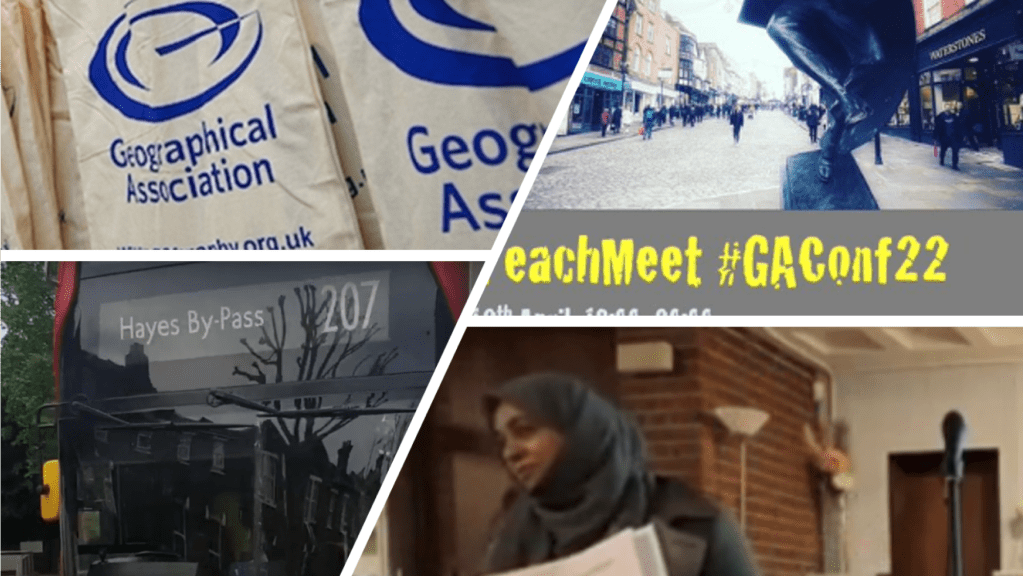
Iram Sammar Teach Meet presentation can be viewed 1:48:27

After a long day at work in school, I waited for the 207 bus to arrive.  The rain was pouring down on me, I had no umbrella and I just wanted to get home.  As I looked on, my bus was approaching, so I waved my hand frantically so it would stop for me. I stepped on to tap my Oyster card, tired and ready to just wind down, when I heard someone shouting at me.

“Don’t let her on. Get off! Go on, go back to where you came from”.  Said an elderly man looking at me with a walking stick and wool-blended cap.  “You’re all over the place, I tell ya…GET ‘ER OFF”.  This elderly man really wanted my attention.

“Sorry sir, are you talking to me?”.  I looked to see if someone was behind me – the doors were shut and the bus began to move. My anguish turned to rage, then a calmness in my heart followed. Secretly, I hoped he was not referring to me. My heart sank. It was not the time or the place to give him a piece of my mind – so I oystered in my card and looked towards the bus driver for some sort of sympathy. None found.

“Don’t talk to me”.  He muffled as he looked out of the window.  “You’re going to take over Britain” he muffled. Every time his gaze swept my way, his discomfort strengthened. So many thoughts flooded my mind. It was embarrassing, it was hurtful, it was demoralising. So, I plucked up the courage and decided to sit, right opposite him.

This man had made his mind up, he decided to embarrass me publicly. He shouted “WHO DO YOU THINK YOU ARE?”, then slithered “…sitting in front of me?”

What struck me was that he really wanted a conversation. So I gave him one to remember.  I plucked up the courage and carried on sitting opposite him so he could see me. “I’m a British citizen…Sir”. Many questions flooded my mind, but I gently asked: “Why are you talking to me like this?”

“GET LOST” was the response. “I’ve got nothing to say to you immigrants.  You’re taking over. GO…BACK…HOME”  he shouted.

“I am going back home…” I took a deep breath “…to Hanwell”. I responded sarcastically, but I chose to look straight into this stranger’s eyes. All I saw was sheer disgust and hate. I felt like my ears were popping and sound was fading, until I took another deep breath and thought to myself, I can challenge this, I do this for a living. After all, I am a geography teacher.

So there I was, alone, me and just this elderly man sitting directly in front of me. He leaned forward a little, so people couldn’t catch his comment: “You know what I mean, go back to where you are from – where your people are from. The same colour as you, the same smell!”

“Where do you think I’m from?” I said, after regaining courage after onlookers rolled their eyes at his arrogant behaviour. Somehow that gave me courage, I took it as a hint of solidarity. I leaned into his territory to replicate the intimidation. Slowly I spoke, “Take a guess”.

The intense pressure of the confrontation switched his mood from conviction to passiveness. He was getting uncomfortable, so he continued, “Oh, I don’t know Tuvalu…I don’t care.  Just get out of here”. His shouting subsided as he was confused as to where I was actually from, which I found extremely amusing.

In my teacher soft tone I said said, “Sir, do you know where Tuvalu is?”

Although this wound him up, he gazed out of the window and said, “you know where you are from, wherever it is, it’s not here”.

“Ah, you mean, the place my parents were born, my heritage?” I helped him in his confusion, as it seemed to me he wanted to know.  At this point there were a few passengers looking on helplessly, not knowing whether it was appropriate to intervene – almost like they too wanted an answer.

“Shut-it.” He broke the discomfort.  This gave me the confidence to probe in search for his better nature.

“By the way, my parents are from Pakistan.  Is that where you would like me to go back to?” I said. “Do you know where Pakistan is…Sir?”

I gave him a chance as you would when you meet your Year nines for the very first time. “I don’t want to talk to your kind.  This is England not Pakistan.”  His words were now disengaged with his heart and soul. Little did this man know that I was a geography teacher and challenging misconceptions and stereotypes had become a part of my job. In fact, I started to smile as I would in a classroom full of questioning eyes. The subaltern speaks, the orient is human, the other does not fear the self proclaimed master in his alleged house.

“Well, you are right about this being England, but you are wrong about Pakistan being my home.  It is my heritage and I absolutely love going there, but I was born here. England is all I know. Alright let’s say I agree… but before I go, I want to ask you something.  What is English? The cup of tea you drink? Or perhaps chocolate you eat?  Sir…do you like tea?”

“Of course I like my tea, that’s what makes us English” , he replied in a smug and satisfied manner.

“Ah, that’s good, but where is your tea from?” I asked and waited for an intelligent response.

“TESCOS, where do you think it’s from?” He sniggered to himself.

“Well actually do you know tea grows in Asian countries, mainly as you mentioned India and China.  You do know that tea was introduced to England by Charles II’s wife Catherine of Braganza because she couldn’t survive without it? Another thing, the tea trade was like no other for Britain. So it was actually traded from India through the British East India Company – actually I would argue that tea was taken or even stolen from over there. You’re now probably wondering about the chocolate, right?  Well you do know that cocoa doesn’t grow in the UK? It’s not hot enough, in fact, it doesn’t rain enough either over here.  In fact, let’s make a deal.  You give me back all the tea, all the chocolate and even the fabric your clothes are made from and I will … go…back…home.”

After giving this gentleman a Year seven or eight geography lesson on Where does our food come from? He fully engaged in conversation. Hook, line and sinker.

“I never really learnt geography in school, I…I…I didn’t know that.”  He said in a calm and almost friendly manner.  “No, but you can understand how I feel, anyway they never had teachers like you, did they?” It was as if he wanted to reason with me, even befriend me. “I just miss the good ol’ days where English people walked about the streets, now it’s full of different people”.  I started to empathise with him. I began to understand what is meant by white fragility as he started to shed a tear. However cruel it sounds, this conversation did start with abuse, but turned into something quite beautiful.

We carried on talking as he was intrigued about where his beloved chocolate was from. So I narrated: “You know what, this reminds me of a conversation I had with one of my students, also a white British boy, just like you. During a geography lesson he told me to ‘go back home’ too just like you did, but after learning about fair trade and the UK’s connection with countries that produce the food we love so much…like chocolate or cocoa, grown in the Ivory Coast and Ghana, he too mellowed up. Also we teach Year nines that, in 1842 the French declared the area their own country, the Ivory Coast, but people were already living there. Do you know the Ivory Coast was a French colonial rule, which was introduced in the 1880s following the scramble for Africa? Not by choice, by force.”

“What right did they have to do that to Africa. It’s interesting that, I thought Africa was a country.” Said this gentleman, now smiling, yet concerned. “What happened to that Coast thingy country?”

“Yes, so…later in 1904, Ivory Coast became part of French West Africa until 1960, after which the country took back their independence from France.” I continued to talk more about the beauty of learning about the indigenous communities and civilisations within places around the world – we talked about racism and how to be anti-racist.

This man now was ready to enter the zone of learning as Ibram X Kendi suggests. He was ready to be an anti-racist. He began to collect his thoughts: “Scramble for Africa, eh…Jesus! All that time I thought Africa was a country! Ivory Coast you say? Maybe I need to read the packet of my chocolate next time…? Haahaha…oooh…ha, chocolate is from the Ivory Coast, never heard of that! So what about Pakistan? What’s the difference between Pakistan and India? Tell me about Pakistan”

“Pakistan, where do I begin? For me it’s a place where most of my extended family lives. More importantly a place where my parents were born. Pakistan was created in 1947, by the collaboration of great leaders like a Pakistani scholar called Jinnah and also Indian scholars such as the wonderful Ghandi…also Nehru. You know these men studied here in England and were very well-spoken and articulate in speech – they organised to get the British Raj out of what was then India – no Pakistan. You know, Pakistan means Land of the Pure. So when they call me a ‘Paki’ they are saying ‘oi pure person’ [we both laughed thunderously]. Unfortunately a British coloniser called Lord Mountbatten was involved in the final negotiations of the partition between Pakistan and India, this left certain territories under dispute, such as Kashmir, Bangladesh and many other communities. What followed was a revolution within those countries and sometimes civil war and…well a mess for the displaced to make sense of the new borders. Bangladesh came out of Pakistan’s final British influenced colonial grip and saw independence. Kashmir…well, they are still in a struggle for self determination, but no one in the UK gets to hear that news. Many ex-colonies were abandoned in a destructive manner.”  

As me and this old man talked and talked, I realised that I had missed my stop, as did he.  Instead of Hanwell we ended up in Shepherd’s Bush. So we both got off the bus and crossed the road together to get to the opposite side and waited for our bus back. Both of us were so engaged in conversation that several buses passed by before we actually decided it was time to go home. When we finally got on to a bus, this gentleman gestured to let me on first! Like a true Englishman.

I have told this story umpteen times in the classroom and the reaction gets better and better as I retell the story. During the Teach Meet 2022 event #GAConf22 (https://www.youtube.com/watch?v=qHqKzM9rwtI&t=7948s) I shared this story once again briefly with fellow geographers, so I wrote this piece for those who requested a full account of events. My engagement with the incredible Decolonise Geography collective (https://decolonisegeography.com/) has opened many opportunities to share my stories. I have tried to recall it the way it happened, but because of memory accountability, forgive me if my recall is not as accurate as real life. My students respond well to this narrative because I get them to talk about how the gentleman was feeling at the start of the conversation and how he changed as he got to know me. I ask my students to question what might have happened if I did not take the time to listen, engage and educate. We get talking about ‘race’ and ‘racism’ without much complication, because if you use real life experiences your students will relate to you and open up about their own experiences. I found this approach to be extremely effective in challenging stereotypes and negative representations in textbooks and various online resources. To be fair, it can be extremely time consuming for teachers to edit and decolonise the curriculum, so a little storytelling can go a long way. I have narrated this to primary and secondary school children all the way up to adults, now you. Having deep conversations with people you feel are ‘racist’ is much better than waiting for a change. Someone else will not come to the rescue.  You can make things happen yourself, little by little. The religion of Islam has taught me that there is a wrong and a right, so as long as you choose the right path, good things will start happening.

A warm thank you for reading this reflection, it comes from the heart. 

Dr Azeezat Johnson: A True Gem

Dr Azeezat Johnson: A True Gem 

Great souls are remembered by those they leave behind, for what is left behind goes not to waste – they are bright gems for those to come. 

Date: Shaban 10, 1443 AH (14 March 2022)

Written by Iram Sammar

بسم الله الرحمن الرحيم

Dr Azeezat Johnson, a brave and heroic author, an anti-racist geographer passed away on the 7th of March 2022. An unimaginable loss for family, friends and colleagues. Her family tweeted ‘Indeed, to Allah (ﷻ) we belong and to Allah (ﷻ) we shall return’ Inna lillahi wa Inna ilayhi rajioon (إِنَّا لِلَّٰهِ وَإِنَّا إِلَيْهِ رَاجِعُون). As I read on, my eyes welled up and my heart became heavy, she was a ‘sister, aunt and friend’ to all who knew her – but why did my own heart feel so much pain? We never met, yet I feel like I have lost a sister, someone I was learning so much from. A sister I looked up to and aspired to be like, one I had so many questions for. Who will I learn from now? She was saying and writing all that I felt in my heart – powerfully entering senseless spaces of prejudice and discrimination, obliterating parameters constructed to breed racism and Islamophobia. Even so, I write this piece with love and care, so those who are familiar with Azeezat’s work will gleam with joy – and those who are not, will discover: who is this inspirational luminary? 

I had just been reading extracts from Azeezat’s co-edited book The fire now: Anti-racist scholarship in times of explicit racial violence and her shared website written pieces for Geographies of Embodiment Research Collective (https://gemcollective.org/), when it occurred to me to get in touch with her. As I opened my Twitter account, I was shocked to find out that Azeezat had passed away. I could not reach out to anyone who knew her to sooth the pain and shock I found myself in. My lack of connections in the spaces she glowed in was apparent. I turned to my mother, only she could comfort me at that moment, so I cried in her arms and said ‘Ammi (mother), I was going to contact Azeezat, but …inna lillahi wa inna ilahi rajioon’.  

My mother comforted me and said, ‘great souls are remembered through their sadaqa jariyah’. In Islam sadaqa jariyah is charity which is not always material/monetary – it can be in the form of education, that continues to benefit mankind not only in the here and now, but in years to come beyond death – with rewards seen on Earth and in the Hereafter, bestowed by Allah (ﷻ), for the charity giver and all who benefit. So, I believe that Azeezat’s work will benefit not only those who are here now, but those who are yet to be born – especially women from every race/ethnicity and religion. 

Azeezat brought a deeper meaning to the discussions around the geographies experienced by Black Muslim women. For me personally, as a Muslim woman living in Britain from the Pakistani heritage, her work gave me hope that there is a narrative beyond the fragile white privileged one we are sometimes forced to accept – or become accustomed to. Azeezat offered a reflective account of what it means to be a Black feminist in academia, beyond the White/Western feminist narrative. This is brave and very difficult at times, especially if you enter spaces where you are looked upon as the ‘other’ or ‘different’. It is not always easy to show courage, sometimes you just want to scream out loud and say: the ‘other’ to who, or ‘different’ to what? Why is there a norm to conform to?

What amazed me most was her rationale for her PhD thesis, which was completed at University of Sheffield – a university with an impressive association with important anti-racist scholars, such as Muna Abdi (@Muna_Abdi_Phd). Azeezat clearly identifies in her writing that Black Muslim women are homogenised into the categorized group of either Black or Muslim, therefore not seen as an intersectional existence which changes the lived experience of the actual Black Muslim woman narrative. Her works places emphasis on the clothing practices of Black Muslim women and the hostility they may face living in Britain and beyond its national borders. Experiences in the airport are perhaps another blog. I often think to my myself, it is so exhausting defending the hijab/niqab/veil. My take on this issue is: oh you, with your disapproving gaze, let us be. Why should I tell you why I wear what I wear – surely it is my choice? 

As I embark on my own doctoral studies based on conceptualising anti-racism and decoloniality in school geography, I feel Azeezat’s work resonates with my own.  Her work on social geography are based on her interests in discussions about intersectional approaches to Black (and) Muslim geographies which resist and confront the marginalisation of Black women. This work is praised for its capabilities to unpack ‘how whiteness is neutralised within spaces of power and how that impacts everyday lived experiences, particularly for Black Muslim women’ (https://www.qmul.ac.uk/geog/staff/johnsona.html ). It is ground-breaking and inspirational not only for Black Muslim women, but also schools and institutions who struggle to address issues of racism (and) islamophobia through meaningful discussions/training on inclusion, diversity and equality as well as equity. These are important aspects of the racialised/homogenised Black Minority Ethnic (BME) lived experiences for institutions (commercial and public/government) to consider fully, not a mere tick box to show that there is an EDI (Equality, Diversity and Inclusion) task force in place.    

Just reading through her twitter account you can see and feel the impact she had on all who knew her. She is a major loss to the Geography community, for her work was unique and inspirational. Azeezat was described by colleagues as a ‘remarkable person in so many ways’ (@AlastairHackney) and some joined Azeezat’s family and loved ones for her Jinazza (funeral) to express their condolences on behalf of her University, Queen Mary University of London. I also studied geography (BA) at the same university, so I had planned a visit which did not materialise. It was evident that Azeezat was ‘a bright & brilliant mind and soul’ (@jonorcup) and touched so many people with her critical contribution to the discipline of geography and beyond. Deepest condolences tweets were shared on her twitter account, one describing her as a ‘bright light in this world and an inspiration to so many’ (@mcneilwillson). No doubt, the academic world was devastated and shared their sadness, as this is a ‘great loss to Geography, feminism and humanity (@ParvatiRaghuram). The GEM collective wrote: ‘”stars don’t shine, they burn” and Azeezat burned so fiercely, so brightly, and will continue to do so for all of us who loved her’ (@gem_collective).

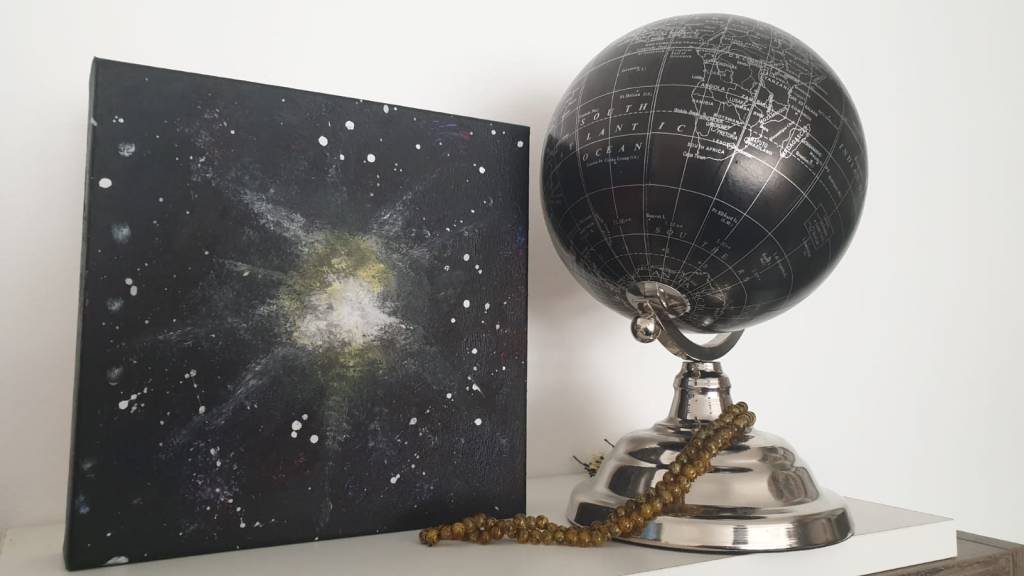
The picture that accompanies this article is of a star, which I painted in honour and gratitude of her soul and Azeezat’s short time on this Earth – the light shone bright مَا شَاءَ ٱللَّٰهُ, something I could not capture. I took inspiration for the painting from Azeezat’s work beautifully transpired in the GEM Research Collective – where a an amazing community of scholars exercise their desire to demand and embody liberation in a space free from the discriminatory gaze. They have successfully built a ‘different reality’ that refuses to isolate their embodiment of experiences from their engagement and production of critical scholarship. As a research community, GEM aim to make their ‘lives more livable’, as do I and many others who might look like us. Through the reconstruction of knowledge production, this space seeks to ask questions that are yet to be explored. For me, their statements pierce the heart to enable the trapped flow of hurt and suffocation caused by being treated like the ‘other’ in a place I always called ‘home’ – Europe, Great Britain, United Kingdom or England. 

A warm thank you for reading this reflection, it comes from the heart. Azeezat’s life mattered, her work mattered and her legacy will matter. I was looking for an excuse to visit and meet this wonderful scholar, sadly this remains a wish that did not come to pass. Allah (ﷻ) grant her Janatul Firdous (the highest level of Heaven). Ameen. 

Iram Sammar

Founder of Salaam Geographia

Iram Sammar is the recipient of the Ordnance Survey Award from the Royal Geographical Society with the Institute of British Geographers for: excellence in geography education at secondary level. She is an education consultant and founder of Salaam Geographia. Along with presenting CPDs and participating in University-based discussion forums, Iram has been writing blogs and book reviews that are recognized as critical for anti-racist and decolonial learning and teaching.

Currently, Iram is working towards a doctoral degree at King’s College London with a focus on decoloniality and antiracist pedagogy in the geography classroom. She has presented her current research and ideas at UCL (IOE); the RGS IBG Postgraduate forum; GEReCo forum on issues and misrepresentation of global south nations. Iram is very vocal about the need to rethink and develop new and innovative ways to introduce decoloniality and anti-racism in school geography. Her experience as a Geography teacher enabled her to develop a passion to promote students’ understanding of indigenous knowledge(s) and historical geography to better understand the impacts of Western European colonialism on the global south.

As a Muslim of Pakistani descent, her work seeks to promote improved ways of talking about race and racism in the classroom – with a focus on the British school context.

Iram holds a Masters in Geography in Education from University College London IOE; a PGCE in Secondary Geography; and a BA in Geography from Queen Mary, University of London.